
|
You entered: Sun
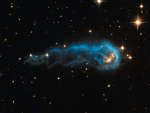 IRAS 20324: Evaporating Protostar
4.09.2013
Will this caterpillar-shaped interstellar cloud one day evolve into a butterfly-shaped nebula? No one is sure. What is sure is that IRAS 20324+4057, on the inside, is contracting to form a new star.
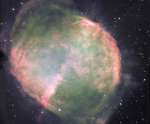 M27: Not A Comet
26.06.2008
Born on June 26th in 1730, astronomer Charles Messier scanned 18th century French skies for comets. To avoid confusion and aid his comet hunting, he diligently recorded this object as number 27 on his list of things which are definitely not comets.
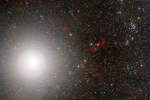 In the Glare of Alpha Centauri
28.06.2012
The glare of Alpha Centauri, one of the brightest stars in planet Earth's night sky, floods the left side of this southern skyscape. A mere 4.3 light-years distant, Alpha Centauri actually consists of two component stars similar in size to the Sun, locked in a mutual orbit.
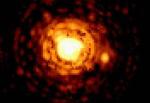 Small Star
20.11.1999
A dim double star system cataloged as Gliese 623 lies 25 light-years from Earth, in the constellation of Hercules. The individual stars of this binary system were distinguished for the first time when the Hubble Space Telescope's Faint Object Camera recorded this image in June 1994.
 Journey into the Cosmic Reef
18.05.2020
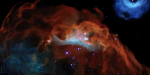
What would you see if you could fly into the Cosmic Reef? The nebular cloud NGC 2014 appear to some like an ocean reef that resides in the sky, specifically in the LMC, the largest satellite galaxy of our Milky Way Galaxy.
 Here Comes Comet Hyakutake
13.03.1996
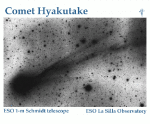
The reaction of ancient peoples to the appearance of bright comets has toppled empires, de-throned kings, and been taken as a sign of great things to come. Probably some of these comets did not get as bright as Comet Hyakutake ("hyah-koo-tah-kay") will in the next two weeks.
 The Swift View of Comet Lulin
21.02.2009
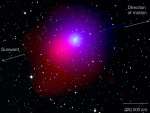
Now growing brighter, Comet Lulin is headed for its closest approach to planet Earth early next week. But the comet's greenish glow, familiar to earthbound skygazers, is replaced by false colors in this premier view from the orbiting Swift satellite.
 Star Colors in Orion
11.02.2011
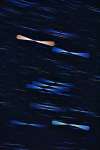
What determines a star's color? Its temperature. Red stars are cool, with surface temperatures of around 3,000 kelvins (K), while blue stars are hotter and can have temperatures over 30,000 K. Our own lovely "yellow" Sun's temperature is a comforting 6,000 K.
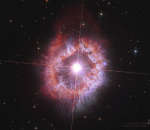 The Outburst Clouds of Star AG Car
26.05.2021
What created these unusual clouds? At the center of this 2021 Hubble image sits AG Carinae, a supergiant star located about 20,000 light-years away in the southern constellation Carina. The star's emitted...
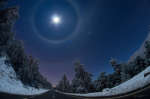 Quadruple Lunar Halo Over Winter Road
2.01.2022
Sometimes falling ice crystals make the atmosphere into a giant lens causing arcs and halos to appear around the Sun or Moon. One Saturday night in 2012 was just such a time near Madrid, Spain, where a winter sky displayed not only a bright Moon but four rare lunar halos.
|
January February March April May June July August September |
|||||||||||||||||||||||||||||||||||||||||||||||||