
|
You entered: Sun
 APOD: 2026 August 29 Б Eclipse Pair
29.08.2026
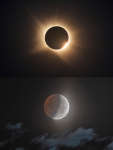
Eclipses tend to come in pairs. Twice a year, during an eclipse season that lasts about 34 days, Sun, Moon, and Earth can nearly align. Then the new and full phases of the Moon, separated by just over 14 days, create a solar and a lunar eclipse.
 SN 2006GY: Brightest Supernova
10.05.2007
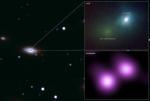
The stellar explosion cataloged as supernova SN 2006gy shines in this wide-field image (left) of its host galaxy, NGC 1260, and expanded view (upper right panel) of the region surrounding the galaxy's core.
 M57: The Ring Nebula
5.06.2013
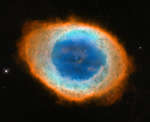
Except for the rings of Saturn, the Ring Nebula (M57) is probably the most famous celestial band. Its classic appearance is understood to be due to our own perspective, though. The recent mapping...
 Aurora over Icelandic Fault
30.08.2016
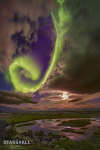
Admire the beauty but fear the beast. The beauty is the aurora overhead, here taking the form of great green spiral, seen between picturesque clouds with the bright Moon to the side and stars in the background. The beast is the wave of charged particles that creates the aurora but might, one day, impair civilization.
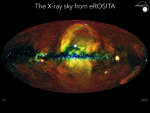 The X Ray Sky from eROSITA
23.06.2020
What if you could see X-rays? The night sky would seem a strange and unfamiliar place. X-rays are about 1,000 times more energetic than visible light photons and are produced by violent explosions and high temperature astronomical environments.
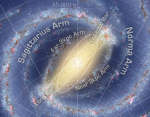 The Far 3kpc Arm
11.07.2008
A major discovery was lurking in the data. By accident, while preparing a talk on the Galaxy's spiral arms for a meeting of the American Astronomical Society, Tom Dame (Harvard-Smithsonian CfA) found it - a new spiral arm in the Milky Way.
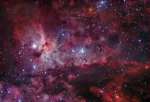 The Great Carina Nebula
9.06.2011
A jewel of the southern sky, the Great Carina Nebula, also known as NGC 3372, spans over 300 light-years, one of our galaxy's largest star forming regions. Like the smaller, more northerly Great...
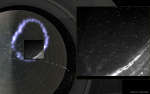 Aurorae and Lightning on Jupiter
24.03.2021
Why does so much of Jupiter's lightning occur near its poles? Similar to Earth, Jupiter experiences both aurorae and lightning. Different from Earth, though, Jupiter's lightning usually occurs near its poles -- while much of Earth's lightning occurs near its equator.
 Caught in the Afterglow
24.11.2011
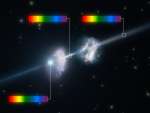
In this artist's illustration, two distant galaxies formed about 2 billion years after the big bang are caught in the afterglow of GRB090323, a gamma-ray burst seen across the Universe. Shining through...
 Julius Caesar and Leap Days
29.02.2024
In 46 BC Julius Caesar reformed the calendar system. Based on advice by astronomer Sosigenes of Alexandria, the Julian calendar included one leap day every four years to account for the fact that an Earth year is slightly more than 365 days long.
|
January February March April May June July August September |
|||||||||||||||||||||||||||||||||||||||||||||||||