
|
You entered: Sun
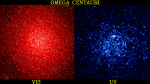 Globular Cluster Omega Centauri
4.10.1996
Does an old, red globular cluster have any hot, blue stars? The rightmost picture, taken by the Ultraviolet Imaging Telescope in ultraviolet light, shows that indeed it does. Pictured, Omega Centauri is the largest known globular cluster in our Galaxy, containing well over a million stars.
 Comet Hale-Bopp Over New York City
8.04.1997
What's that point of light above the World Trade Center? It's Comet Hale-Bopp! Both faster than a speeding bullet and able to "leap" tall buildings in its single orbit, Comet Hale-Bopp is also bright enough to be seen even over the glowing lights of one of the world's premier cities.
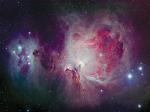 The Great Nebula in Orion
27.09.2004
The Great Nebula in Orion is a colorful place. Visible to the unaided eye, it appears as a small fuzzy patch in the constellation of Orion. Long exposure, digitally sharpened images like this, however, show the Orion Nebula to be a busy neighborhood of young stars, hot gas, and dark dust.
 Moon and Planets in the Morning
22.10.2009
Last Friday, a gathering of three bright planets and the Moon graced the morning sky. With Mercury, Venus, Saturn, and a narrow lunar crescent close to the eastern horizon in the dawn twilight, this picture of the beautiful conjunction was recorded near Noerdlingen, Germany.
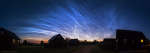 Veins of Heaven
31.07.2014
Transfusing sunlight through a a still dark sky, this exceptional display of noctilucent clouds was captured earlier this month above the island of Gotland, Sweden. From the edge of space, about 80 kilometers above...
 Eclipse at Moonrise
11.10.2014
As the Moon rose and the Sun set on October 8, a lunar eclipse was in progress seen from Chongqing, China. Trailing through this composite time exposure, the rising Moon began as a dark reddened disk in total eclipse near the eastern horizon.
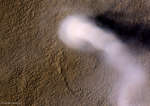 A Dust Devil on Mars
2.03.2015
It was late in the northern martian spring when the HiRISE camera onboard the Mars Reconnaissance Orbiter spied this local denizen. Tracking across the flat, dust-covered Amazonis Planitia in 2012, the core of this whirling dust devil is about 140 meters in diameter.
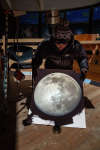 Direct Projection: The Moon in My Hands
28.02.2022
You don't have to look through a telescope to know where it's pointing. Allowing the telescope to project its image onto a large surface can be useful because it dilutes the intense brightness of very bright sources. Such dilution is useful for looking at the Sun, for example during a solar eclipse.
 Comet Pons-Brooks at Night
4.04.2024
In dark evening skies over June Lake, northern hemisphere, planet Earth, Comet 12P/Pons-Brooks stood just above the western horizon on March 30. Its twisted turbulent ion tail and diffuse greenish coma are captured in this two degree wide telescopic field of view along with bright yellowish star Hamal also known as Alpha Arietis.
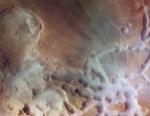 Colorful Water Clouds Over Mars
17.04.2001
One place where water can be found on Mars is in clouds. In the above picture colorful water clouds are visible just after sunrise in and around a maze of canyons known as Noctis Labyrinthus (the labyrinth of the night).
|
January February |
|||||||||||||||||||||||||||||||||||||||||||||||||