
|
You entered: Sun
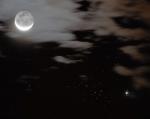 Jupiter, Moons, and Bees
25.09.2002
Rising before the Sun on September 4, Jupiter and an old cresent Moon gathered in the dim constellation of Cancer. Watching from a hillside near Austin, Texas, planet Earth, astrophotographer Russell Croman recorded this view of their passing as clouds gracefully dimmed the brilliant moonlight.
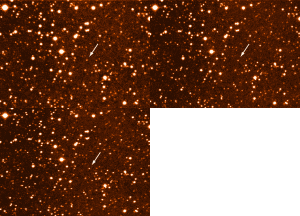 Quaoar: Large Asteroid in the Outer Solar System
9.10.2002
Asteroids almost as large as planets are still being discovered in our own Solar System. Recently an asteroid more than half the size of Pluto was found orbiting at a distance only a little further than the Solar System's most distant planet.
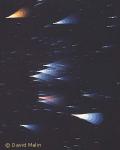 Orion Star Colours
29.08.1998
What determines a star's colour? Its temperature. Red stars are cool, around 3,000 kelvins (K), while blue stars are hotter and can have temperatures over 30,000 K. Our own lovely yellow Sun's temperature is a comforting 6,000 K.
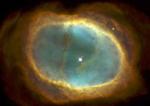 NGC 3132: The Eight Burst Nebula
10.11.1998
It's the dim star, not the bright one, near the center of NGC 3132 that created this odd but beautiful planetary nebula. Nicknamed the Eight-Burst Nebula and the Southern Ring Nebula, the glowing gas originated in the outer layers of a star like our Sun.
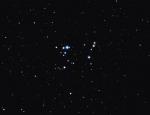 The 37 Cluster
18.11.2005
For the mostly harmless denizens of planet Earth, the brighter stars of open cluster NGC 2169 seem to form a cosmic 37. (Did you expect 42?.) Of course, the improbable numerical asterism appears solely by chance and lies at an estimated distance of 3,600 light-years toward the constellation Orion.
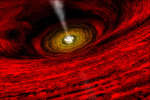 GRO J1655 40: Evidence for a Spinning Black Hole
5.09.2010
In the center of a swirling whirlpool of hot gas is likely a beast that has never been seen directly: a black hole. Studies of the bright light emitted by the swirling gas frequently indicate not only that a black hole is present, but also likely attributes.
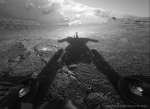 Shadow of a Martian Robot
17.02.2019
What if you saw your shadow on Mars and it wasn't human? Then you might be the Opportunity rover currently exploring Mars. Opportunity explored the red planet from 2004 to 2018, finding evidence of ancient water, and sending breathtaking images across the inner Solar System.
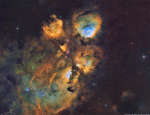 NGC 6334: The Cats Paw Nebula
10.05.2022
Nebulas are perhaps as famous for being identified with familiar shapes as perhaps cats are for getting into trouble. Still, no known cat could have created the vast Cat's Paw Nebula visible toward the constellation of the Scorpion (Scorpius.
 APOD: 2025 August 30 Б A Two Percent Moon
30.08.2025
A young crescent moon can be hard to see. That's because when the Moon shows it's crescent phase (young or old) it can never be far from the Sun in planet Earth's sky.
 The Weather on Mars
24.03.1997
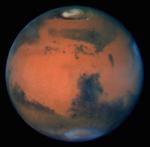
Would Mars be a nice place to visit? Sometimes. Much of Mars undergoes severe changes in climate during its orbit around the Sun, ranging from extreme cold to temperatures enjoyable by humans. But Mars...
|
January February |
|||||||||||||||||||||||||||||||||||||||||||||||||