
|
You entered: Sun
 Comet G3 ATLAS: a Tail and a Telescope
24.01.2025
Comet C/2024 G3 ATLAS has made a dramatic appearance in planet Earth's skies. A visitor from the distant Oort Cloud, the comet reached its perihelion on January 13. On January 19, the bright comet was captured here from ESO Paranal Observatory in the Atacama desert in Chile.
 A Conjunction of Crescents
8.02.2025
A waxing crescent Moon and a waning crescent Venus are found at opposite corners of this twilight telephoto field of view. The close conjunction of the two brightest celestial beacons in planet Earth's western evening sky was captured on February 1 from Rosario, Argentina.
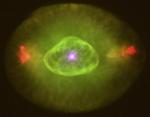 NGC 6826: The Blinking Eye
26.05.2001
The colorful planetary nebula phase of a sun-like star's life is brief. Almost in the "blink of an eye" - cosmically speaking - the star's outer layers are cast off, forming an expanding emission nebula. This nebula lasts perhaps 10 thousand years compared to a 10 billion year stellar life span.
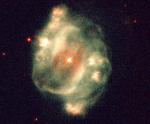 NGC 5307: A Symmetric Planetary Nebula
31.12.1997
Some stellar nebulae are strangely symmetric. For example, every major blob of gas visible on the upper left of NGC 5307 appears to have a counterpart on the lower right. This picture taken by the Hubble Space Telescope was released last week. NGC 5307 is an example of a planetary nebula with a spiral shape.
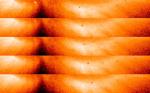 X-ray Transit of Mercury
2.07.1998
This sequence of false color X-ray images captures a rare event - the passage or transit of planet Mercury in front of the Sun. Mercury's small disk is silhouetted against the bright background of X-rays from the hot Solar Corona.
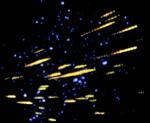 Meteors Now and Again
10.08.1998
The Perseid Meteor Shower, usually the best meteor shower of the year, will peak over the next two nights. Over the course of an hour, a person watching a clear sky from a dark location might see as many as 100 meteors.
 Venus: Just Passing By
25.06.2005
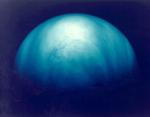
Venus, the second closest planet to the Sun, is by far the brightest of the three planets gathered in this weekend's western sky at sunset. It has also proven to be a popular way-point for spacecraft headed for the gas giant planets in the outer reaches of the solar system. Why visit Venus first?
 The View toward Husband Hill on Mars
3.07.2006
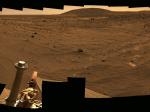
This Martian vista is only part of one of the greatest panoramic views of Mars that has ever attempted. The expansive mosaic is helping to keep the robotic Spirit rover busy over the energy draining winter in the southern hemisphere of Mars.
 NGC 6334: The Cats Paw Nebula
4.03.2008
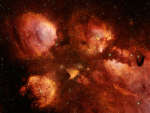
Nebulae are perhaps as famous for being identified with familiar shapes as perhaps cats are for getting into trouble. Still, no known cat could have created the vast Cat's Paw Nebula visible in Scorpius.
 The Double Cluster
4.12.2009
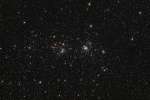
A lovely starfield in the heroic northern constellation Perseus holds this famous pair of open or galactic star clusters, h and Chi Perseii. Also cataloged as NGC 869 (right) and NGC 884, both clusters are about 7,000 light-years away and contain stars much younger and hotter than the Sun.
|
January February |
|||||||||||||||||||||||||||||||||||||||||||||||||