
|
You entered: Sun
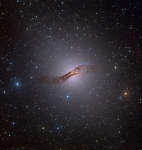 Centaurus A
17.03.2022
A mere 11 million light-years away, Centaurus A is the closest active galaxy to planet Earth. Spanning over 60,000 light-years, the peculiar elliptical galaxy also known as NGC 5128, is featured in this sharp telescopic view.
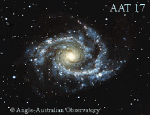 Grand Design Spiral Galaxy NGC 2997
30.10.1996
NGC 2997 is a grand design spiral galaxy. Its small nucleus and sprawling spiral arms give it a type "Sc" designation. NGC 2997 is speeding away from us at about 1100 kilometers...
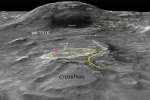 Mars Rover Races to Survive
12.12.2007
The Martian rover Spirit is now in the race of its life. The rolling robot is trying to reach an outpost to spend the winter, but it keeps getting bogged down in soft sand on Mars.
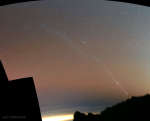 Comet Leonards Long Tail
3.01.2022
You couldn't see Comet LeonardБs extremely long tail with a telescope Б it was just too long. You also couldn't see it with binoculars Б still too long. Or with your eyes -- it was too dim. Or from a city Б the sky was too bright.
 Comet Ikeya Zhang Meets The ISS
26.04.2002
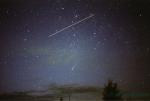
Still catching the Sun's rays, the International Space Station (ISS) cruises across the early evening sky above Tomahawk, Wisconsin, USA. Recorded on April 9 around 9 pm CDT in a 30 second exposure, the sunlit space station traced this bright streak moving east (right) through the constellation Cassiopeia.
 The X-Ray Moon
29.09.1996
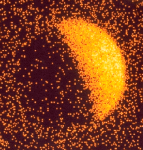
This X-Ray image of the Moon was made by the orbiting Roentgen Observatory Satellite (ROSAT) in 1990. It shows three distinct regions: a bright X-ray sky, a bright part of the Moon, and a relatively dark part of the Moon. The bright X-ray sky is due to the diffuse cosmic X-ray background.
 A Big Cliff on Jupiter's Callisto
18.02.1997
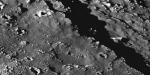
Callisto's surface is not without fault. In fact, an explorer crossing the surface of this large moon of Jupiter would need climbing equipment to pass this large, recently discovered fault. The above picture was released last week and was taken in November 1996 by the robot spacecraft Galileo currently orbiting Jupiter.
 The Cats Paw Nebula
17.07.2003
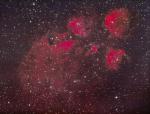
As soon as we find out whose cat did this . . . Nebulae are as famous for being identified with familiar shapes as perhaps cats are for getting into trouble. No cat, though, could have created the vast Cat's Paw Nebula visible in Scorpius.
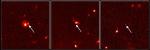 A Distant Destiny
14.01.1998
Watching galaxies recede, observational astronomers of the 20th century discovered an astounding fact - the Universe is expanding. Will it continue to expand forever? The speed of light is finite so looking into the distant Universe is equivalent to looking at the distant past.
 Lunation
29.08.2004
Our Moon's appearance changes nightly. This time-lapse sequence shows what our Moon looks like during a lunation, a complete lunar cycle. As the Moon orbits the Earth, the half illuminated by the Sun first becomes increasingly visible, then decreasingly visible. The Moon always keeps the same face toward the Earth.
|
January February |
|||||||||||||||||||||||||||||||||||||||||||||||||