
|
You entered: Sun
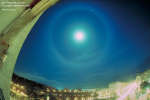 A Halo Around the Moon
7.12.2008
Have you ever seen a halo around the Moon? This fairly common sight occurs when high thin clouds containing millions of tiny ice crystals cover much of the sky. Each ice crystal acts like a miniature lens.
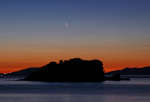 Venus and Jupiter at Dawn
21.08.2014
On Monday morning, Venus and Jupiter gathered close in dawn skies, for some separated by about half the width of a full moon. It was their closest conjunction since 2000, captured here above the eastern horizon before sunrise.
 Lunar View, Solar Eclipse
31.08.2017
Orbiting above the lunar nearside on August 21, the Lunar Reconnaissance Orbiter turned to look back on a bright, Full Earth. As anticipated its Narrow Angle Camera scanned this sharp view of our fair...
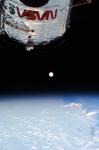 Earth, Moon, Hubble
5.01.2000
The Space Shuttle Discovery Crew was fortunate enough to witness one of the brighter full moon's from orbit two weeks ago during their mission to fix the Hubble Space Telescope. Pictured...
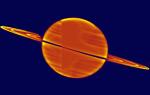 Sunlight Through Saturns Rings
24.06.2000
Normally, earth-bound astronomers view Saturn's spectacular ring system fully illuminated by reflected sunlight. However, this intriguing picture was made to take advantage of an unusual orientation, with the Sun actually illuminating the rings from below. The three bright ring features are visible because the rings themselves are not solid.
 Moon, Mars, Venus, and Spica
4.12.2002
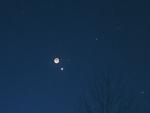
Gliding toward today's total eclipse of the Sun, the crescent Moon has been rising early, just before dawn. And as a prelude to its close solar alignment, the Moon also completed a lovely celestial triangle, closing with bright planets Mars and Venus on the morning of December 1.
 Lunation
10.08.2003
Our Moon's appearance changes nightly. This time-lapse sequence shows what our Moon looks like during a lunation, a complete lunar cycle. As the Moon orbits the Earth, the half illuminated by the Sun first becomes increasingly visible, then decreasingly visible. The Moon always keeps the same face toward the Earth.
 Infrared Uranus
20.10.1998
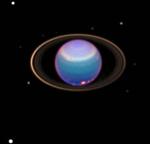
The Sun's third largest planet usually looks quite dull. Uranus typically appears as a featureless small spot in a small telescope or a featureless large orb in a large telescope. Last August, however...
 Lunation
13.11.2005
Our Moon's appearance changes nightly. This time-lapse sequence shows what our Moon looks like during a lunation, a complete lunar cycle. As the Moon orbits the Earth, the half illuminated by the Sun first becomes increasingly visible, then decreasingly visible. The Moon always keeps the same face toward the Earth.
 Regulus Occulted
2.08.1999
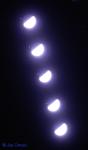
On May 21, viewed from the continental US, a star winked out as it passed behind the dark limb of the first-quarter Moon. The star, Regulus, is hotter than the sun, about 69 light-years distant, and shines in Earth's skies as the brightest star in the constellation Leo, the Lion.
|
January February |
|||||||||||||||||||||||||||||||||||||||||||||||||