
|
You entered: neutron
 Water Ice Detected Beneath Moons Surface
25.10.2010
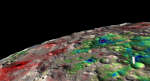
Is there enough water on the moon to sustain future astronauts? The question has important implications if humanity hopes to use the Moon as a future outpost. Last year, to help find out, scientists crashed the moon-orbiting LCROSS spacecraft into a permanently shadowed crater near the Moon's South Pole.
 The Once and Future Stars of Andromeda
20.01.2011
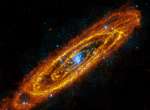
The big, beautiful Andromeda Galaxy, aka M31, is a spiral galaxy a mere 2.5 million light-years away. Two space-based observatories have combined to produce this intriguing composite image of Andromeda, at wavelengths outside the visible spectrum. The remarkable view follows the locations of this galaxy's once and future stars.
 M1: The Crab Nebula
9.11.2023
The Crab Nebula is cataloged as M1, the first object on Charles Messier's famous 18th century list of things which are not comets. In fact, the Crab is now known to be a supernova remnant, debris from the death explosion of a massive star witnessed by astronomers in the year 1054.
 Simeis 147: Supernova Remnant
18.05.2017
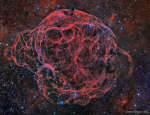
It's easy to get lost following intricate filaments in this detailed image of faint supernova remnant Simeis 147. Also cataloged as Sharpless 2-240 it goes by the popular nickname, the Spaghetti Nebula. Seen toward the boundary of the constellations Taurus and Auriga, it covers nearly 3 degrees or 6 full moons on the sky.
 Composite Crab
26.10.2006
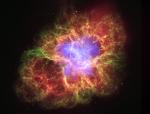
The Crab Nebula is cataloged as M1, the first object on Charles Messier's famous list of things which are not comets. In fact, the Crab is now known to be a supernova remnant, expanding debris from the death explosion of a massive star.
 The Swirling Core of the Crab Nebula
8.07.2016
At the core of the Crab Nebula lies a city-sized, magnetized neutron star spinning 30 times a second. Known as the Crab Pulsar, it's actually the rightmost of two bright stars, just below a central swirl in this stunning Hubble snapshot of the nebula's core.
 Quantum Gravity Claimed Detected on Earth
22.01.2002
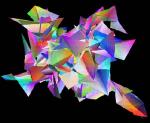
Does gravity come in chucks? A theory known as Quantum Mechanics tells us about how the universe works on the smallest scales, while Einstein's General Theory of Relativity tells us about how gravity and the universe works on the largest scales. So far, no complete theory has been able to encompass them both.
 M51: X Rays from the Whirlpool
11.07.2002
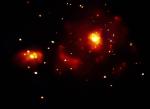
Fresh from yesterday's episode, a popular pair of interacting galaxies known as the Whirlpool debut here beyond the realm of visible light -- imaged at high energies by the orbiting Chandra X-ray Observatory. Still turning in a remarkable performance, over 80 glitering x-ray stars are present in the Chandra image data from the region.
 Simeis 147: Supernova Remnant
21.11.2019
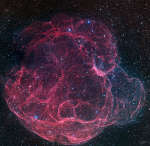
It's easy to get lost following the intricate looping filaments in this detailed image of supernova remnant Simeis 147. Also cataloged as Sharpless 2-240 it goes by the popular nickname, the Spaghetti Nebula.
 Simeis 147: Supernova Remnant
10.12.2020
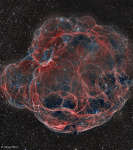
It's easy to get lost following the intricate looping filaments in this detailed image of supernova remnant Simeis 147. Also cataloged as Sharpless 2-240 it goes by the popular nickname, the Spaghetti Nebula.
|
January February March April May June July August September October |
|||||||||||||||||||||||||||||||||||||||||||||||||