
|
You entered: neutron
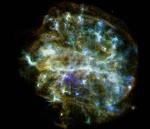 Elements in the Aftermath
26.10.2001
Massive stars spend their brief lives furiously burning nuclear fuel. Through fusion at extreme temperatures and densities surrounding the stellar core, nuclei of light elements like Hydrogen and Helium are combined to heavier elements like Carbon, Oxygen, etc. in a progression which ends with Iron.
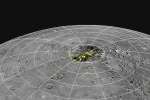 Northern Mercury
1.12.2012
Innermost planet Mercury would probably not be a good location for an interplanetary winter olympics. But new results based on data from the Mercury orbiting MESSENGER spacecraft indicate that it does have substantial water ice in permanently shadowed regions within craters near its north pole.
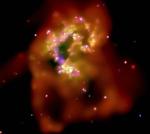 X Rays From Antennae Galaxies
3.02.2004
A bevy of black holes and neutron stars shine as bright, point-like sources against bubbles of million degree gas in this false-color x-ray image from the orbiting Chandra Observatory. The striking picture spans about...
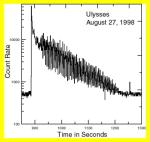 SGR 1900+14 : Magnetar
3.09.1998
On August 27th an intense flash of X-rays and gamma-rays swept through our Solar System. Five spacecraft of the Third InterPlanetary gamma-ray burst Network, Ulysses, WIND, RXTE, NEAR, and BeppoSAX, recorded the high energy...
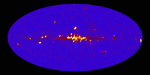 The X-Ray Sky
2.01.1996
What if you could see X-rays? If you could, the night sky would be a strange and unfamiliar place. X-rays are about 1,000 times more energetic than visible light photons and are produced in violent and high temperature astrophysical environments.
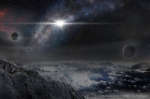 A Candidate for the Biggest Boom Yet Seen
26.01.2016
It is a candidate for the brightest and most powerful explosion ever seen -- what is it? The flaring spot of light was found by the All Sky Automated Survey for Supernovae (ASASSN) in June of last year and labelled ASASSN-15lh.
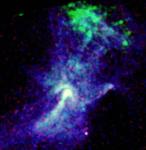 X Rays And The Circinus Pulsar
13.09.2001
A bizarre stellar corpse 19,000 light-years from Earth, pulsar PSR B1509-58 beckons from the small southern constellation of Circinus. Like its cousin at the heart of the Crab nebula, the Circinus pulsar is a rapidly spinning, magnetized neutron star.
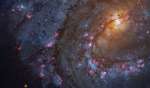 In the Arms of M83
11.11.2011
Big, bright, and beautiful, spiral galaxy M83 lies a mere twelve million light-years away, near the southeastern tip of the very long constellation Hydra. This cosmic close-up, a mosaic based on data from...
 X Ray Mystery in RCW 38
27.12.2002
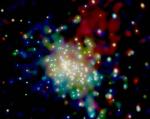
A mere 6,000 light-years distant and sailing through the constellation Vela, star cluster RCW 38 is full of powerful stars. It's no surprise that these stars, only a million years young with hot outer atmospheres, appear as point-like x-ray sources dotting this x-ray image from the orbiting Chandra Observatory.
 X Ray Mystery in RCW 38
8.01.2005
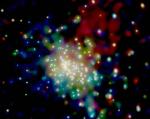
A mere 6,000 light-years distant and sailing through the constellation Vela, star cluster RCW 38 is full of powerful stars. It's no surprise that these stars, only a million years young with hot outer atmospheres, appear as point-like x-ray sources dotting this x-ray image from the orbiting Chandra Observatory.
|
January February March April May June July August September October |
|||||||||||||||||||||||||||||||||||||||||||||||||