
|
You entered: neutron
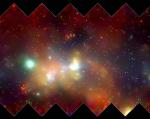 X Ray Milky Way
10.01.2002
If you had x-ray vision, the center regions of our galaxy would not be hidden from view by immense cosmic dust clouds opaque to visible light. Instead, the Milky Way toward Sagittarius might look something like this stunning mosaic of images from the orbiting Chandra Observatory.
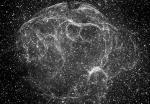 Simeis 147: Supernova Remnant
30.08.2002
It's easy to get lost following the intricate filaments in this stunningly detailed image of faint supernova remnant Simeis 147. Seen towards the constellation Taurus it covers nearly 3 degrees (6 full moons)...
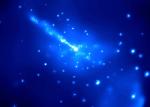 Centaurus A: X-Rays from an Active Galaxy
5.07.2003
Its core hidden from optical view by a thick lane of dust, the giant elliptical galaxy Centaurus A was among the first objects observed by the orbiting Chandra X-ray Observatory. Astronomers were not disappointed, as Centaurus A's appearance in x-rays makes its classification as an active galaxy easy to appreciate.
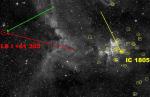 Microquasar in Motion
16.09.2004
Microquasars, bizarre binary star systems, generating high-energy radiation and blasting out jets of particles at nearly the speed of light, live in our Milky Way galaxy. The energetic microquasar systems seem to consist...
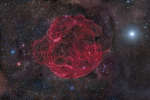 Simeis 147: Supernova Remnant
9.10.2012
It's easy to get lost following the intricate filaments in this detailed mosaic image of faint supernova remnant Simeis 147 (S147). Also cataloged as Sh2-240, it covers nearly 3 degrees or 6 full moons on the sky. That's about 150 light-years at the stellar debris cloud's estimated distance of 3,000 light-years.
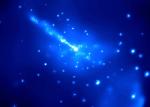 Centaurus A: X Rays from an Active Galaxy
16.08.2001
Its core hidden from optical view by a thick lane of dust, the giant elliptical galaxy Centaurus A was among the first objects observed by the orbiting Chandra X-ray Observatory. Astronomers were not disappointed, as Centaurus A's appearance in x-rays makes its classification as an active galaxy easy to appreciate.
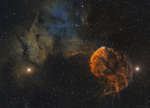 Sharpless 249 and the Jellyfish Nebula
7.03.2019
Normally faint and elusive, the Jellyfish Nebula is caught in this alluring telescopic field of view. The entire scene is a two panel mosaic constructed using narrowband image data, with emission from sulfur, hydrogen and oxygen atoms shown in red, green and blue hues.
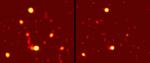 The High Energy Heart Of The Milky Way
29.07.1998
These high resolution false color pictures of the Galactic center region in high energy X-ray and gamma-ray light result from a very long exposure of roughly 3,000 hours performed from 1990 to 1997 by the French SIGMA telescope onboard the Russian GRANAT spacecraft.
 The Jellyfish and Mars
19.05.2021
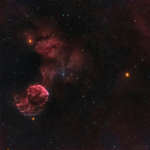
Normally faint and elusive, the Jellyfish Nebula is caught in this alluring scene. In the telescopic field of view two bright yellowish stars, Mu and Eta Geminorum, stand just below and above the Jellyfish Nebula at the left. Cool red giants, they lie at the foot of the celestial twin.
 X Ray Milky Way
12.07.2003
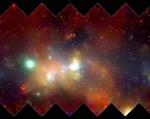
If you had x-ray vision, the center regions of our Galaxy would not be hidden from view by the immense cosmic dust clouds opaque to visible light. Instead, the Milky Way toward Sagittarius might look something like this stunning mosaic of images from the orbiting Chandra Observatory.
|
January February March April May June July August September October |
|||||||||||||||||||||||||||||||||||||||||||||||||