
|
You entered: neutron
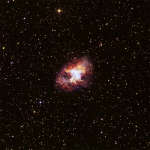 Cosmic Crab Nebula
25.07.2014
The Crab Pulsar, a city-sized, magnetized neutron star spinning 30 times a second, lies at the center of this tantalizing wide-field image of the Crab Nebula. A spectacular picture of one of our Milky Way's supernova remnants, it combines optical survey data with X-ray data from the orbiting Chandra Observatory.
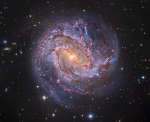 M83: The Thousand Ruby Galaxy
8.10.2015
Big, bright, and beautiful, spiral galaxy M83 lies a mere twelve million light-years away, near the southeastern tip of the very long constellation Hydra. Prominent spiral arms traced by dark dust lanes and blue star clusters lend this galaxy its popular name, The Southern Pinwheel.
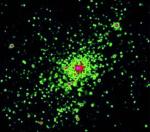 NGC 3603: X-Rays From A Starburst Cluster
24.01.2001
A mere 20,000 light-years from the Sun lies the NGC 3603 star cluster, a resident of the nearby Carina spiral arm of our Milky Way galaxy. Seen here in this recent false-color x-ray...
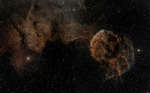 Sharpless 249 and the Jellyfish Nebula
2.12.2014
Normally faint and elusive, the Jellyfish Nebula is caught in this alluring telescopic mosaic. The scene is anchored right and left by two bright stars, Mu and Eta Geminorum, at the foot of the celestial twin while the Jellyfish Nebula is the brighter arcing ridge of emission with dangling tentacles below and right of center.
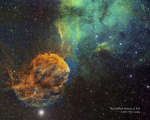 Sharpless 249 and the Jellyfish Nebula
7.01.2017
Normally faint and elusive, the Jellyfish Nebula is caught in this alluring telescopic mosaic. The scene is anchored below by bright star Eta Geminorum, at the foot of the celestial twin, while the Jellyfish Nebula is the brighter arcing ridge of emission with tentacles dangling below and left of center.
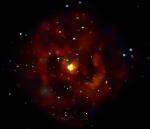 X Rays from M83
6.02.2003
Bright and beautiful spiral galaxy M83 lies a mere twelve million light-years from Earth, toward the headstrong constellation Hydra. Sweeping spiral arms, prominent in visible light images, lend this galaxy its popular moniker -- the Southern Pinwheel.
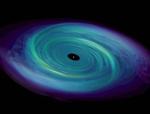 Accretion Disk Simulation
12.03.2005
Don't be fooled by the familiar pattern. The graceful spiral structure seen in this computer visualization does not portray winding spiral arms in a distant galaxy of stars. Instead, the graphic shows spiral...
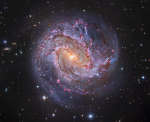 M83: The Thousand Ruby Galaxy
29.06.2019
Big, bright, and beautiful, spiral galaxy M83 lies a mere twelve million light-years away, near the southeastern tip of the very long constellation Hydra. Prominent spiral arms traced by dark dust lanes and blue star clusters lend this galaxy its popular name, The Southern Pinwheel.
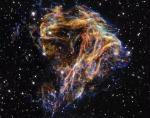 N49 s Cosmic Blast
4.07.2003
Scattered debris from a cosmic supernova explosion lights up the sky in this gorgeous composited image based on data from the Hubble Space Telescope. Cataloged as N49, these glowing filaments of shocked gas span about 30 light-years in our neighboring galaxy, the Large Magellanic Cloud.
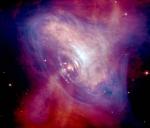 Composite Crab
26.03.2005
(xxxre linkxxx) The Crab Pulsar, a city-sized, magnetized neutron star spinning 30 times a second, lies at the center of this composite image of the inner region of the well-known Crab Nebula. The spectacular...
|
January February March April May June July August September October |
|||||||||||||||||||||||||||||||||||||||||||||||||