
|
You entered: neutron
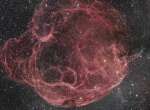 Simeis 147: Supernova Remnant
11.02.2011
It's easy to get lost following the intricate filaments in this detailed mosaic image of faint supernova remnant Simeis 147. Also cataloged as Sh2-240 and seen towards the constellation Taurus, it covers nearly 3 degrees (6 full moons) on the sky.
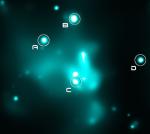 The Swarm
29.07.2006
What do you call a group of black holes ... a flock, a brace, a swarm? Monitoring a region around the center of our Galaxy, astronomers have indeed found evidence for a surprisingly large number...
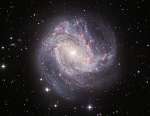 M83: The Thousand Ruby Galaxy
27.09.2008
Big, bright, and beautiful, spiral galaxy M83 lies a mere twelve million light-years away, near the southeastern tip of the very long constellation Hydra. Prominent spiral arms traced by dark dust lanes and blue star clusters lend this galaxy its popular name of the Southern Pinwheel.
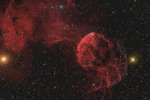 Elusive Jellyfish Nebula
14.05.2009
Normally faint and elusive, the Jellyfish Nebula is caught in this alluring wide-field telescopic view. Flanked by two yellow-tinted stars, Mu and Eta Geminorum, at the foot of a celestial twin, the Jellyfish Nebula is the brighter arcing ridge of emission with dangling tentacles right of center.
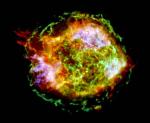 APOD: 2004 August 26- Cassiopeia A in a Million
26.08.2004
One million seconds of x-ray image data were used to construct this view of supernova remnant Cassiopeia A, the expanding debris cloud from a stellar explosion. The stunningly detailed image from the Chandra Observatory will allow an unprecedented exploration of the catastrophic fate that awaits stars much more massive than the Sun.
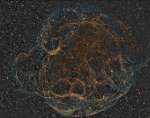 Simeis 147: Supernova Remnant
30.01.2009
It's easy to get lost following the intricate filaments in this detailed image of faint supernova remnant Simeis 147. Also cataloged as Sh2-240 and seen towards the constellation Taurus, it covers nearly 3 degrees (6 full moons) on the sky.
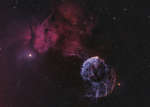 Sharpless 249 and the Jellyfish Nebula
26.02.2026
Normally faint and elusive, the Jellyfish Nebula is caught in this alluring telescopic field of view. Floating in the interstellar sea, the nebula is anchored right and left by two bright stars, Mu and Eta Geminorum, at the foot of the celestial twins.
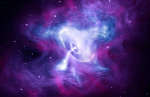 The Crab from Space
16.03.2018
The Crab Nebula is cataloged as M1, the first object on Charles Messier's famous list of things which are not comets. In fact, the Crab is now known to be a supernova remnant, expanding debris from the death explosion of a massive star.
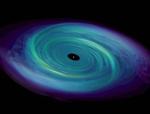 Accretion Disk Simulation
27.09.2002
Don't be fooled by the familiar symmetry. The graceful spiral structure seen in this computer visualization does not portray winding spiral arms in a distant galaxy of stars. Instead, the graphic shows spiral...
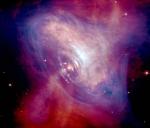 Composite Crab
4.09.2003
The Crab Pulsar, a city-sized, magnetized neutron star spinning 30 times a second, lies at the center of this composite image of the inner region of the well-known Crab Nebula. The spectacular picture combines...
|
January February March April May June July August September October |
|||||||||||||||||||||||||||||||||||||||||||||||||