
|
You entered: gas
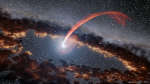 A Black Hole Disrupts a Passing Star
23.03.2020
What happens to a star that goes near a black hole? If the star directly impacts a massive black hole, then the star falls in completely -- and everything vanishes. More likely, though, the star...
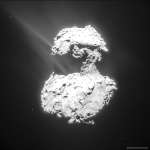 APOD: 2025 October 19 Б Comet Churyumov Gerasimenko Creates Its Tails
18.10.2025
Where do comet tails come from? There are usually no obvious places on the nuclei of comets from which the jets that create comet tails emanate. One of the best images of emerging jets...
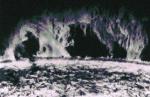 A Prominent Solar Prominence
26.01.1997
One of the most spectacular solar sights is a prominence. A solar prominence is a cloud of solar gas held above the Sun's surface by the Sun's magnetic field. The Earth would easily fit under one of the loops of the prominence shown in the above picture.
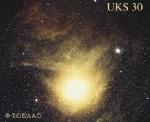 Antares
26.07.1998
Antares is a huge star. In a class called red supergiant, Antares is about 700 times the diameter of our own Sun, 15 times more massive, and 10,000 times brighter. Antares is the brightest star in the constellation of Scorpius and one of the brighter stars in all the night sky.
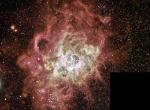 NGC 604: Giant Stellar Nursery
8.12.2003
Stars are sometimes born in the midst of chaos. About 3 million years ago in the nearby galaxy M33, a large cloud of gas spawned dense internal knots which gravitationally collapsed to form stars. NGC 604 was so large, however, it could form enough stars to make a globular cluster.
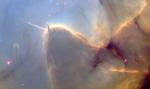 Trifid Pillars and Jets
27.12.2003
Dust pillars are like interstellar mountains. They survive because they are more dense than their surroundings, but they are being slowly eroded away by a hostile environment. Visible in the above picture...
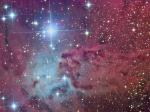 The Fox Fur Nebula
13.03.2005
The nebula surrounding bright star S Mon is filled with dark dust and glowing gas. The strange shapes originate from fine interstellar dust reacting in complex ways with the energetic light and hot gas being expelled by the young stars.
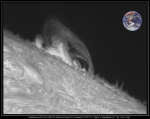 Sun and Prominence
4.03.2014
Dramatic prominences can sometimes be seen looming just beyond the edge of the sun. Such was the case last week as a large prominence, visible above, highlighted a highly active recent Sun. A waving...
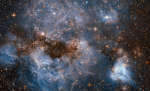 N159 in the Large Magellanic Cloud
27.01.2017
Over 150 light-years across, this cosmic maelstrom of gas and dust is not too far away. It lies south of the Tarantula Nebula in our satellite galaxy the Large Magellanic Cloud a mere 180,000 light-years distant. Massive stars have formed within.
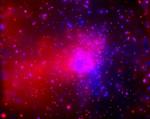 X Rays from M17
21.08.2003
About 5,000 light-years away, toward the constellation Sagittarius and the center of our galaxy, lies the bright star forming region cataloged as M17. In visible light, M17's bowed and hollowed-out appearance has resulted in many popular names like the Horseshoe, Swan, Omega, and Lobster nebula. But what has sculpted this glowing gas cloud?
|
January February March April May June July August September October November |
||||||||||||||||||||||||||||||||||||||||||||||||||||||||