
|
You entered: gas
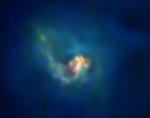 Centaurus Galaxy Cluster in X Rays
28.03.2002
The Centaurus Cluster is a swarm of hundreds of galaxies a mere 170 million light-years away. Like other immense galaxy clusters, the Centaurus Cluster is filled with gas at temperatures of 10 million degrees or more, making the cluster a luminous source of cosmic x-rays.
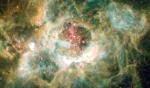 In the Center of NGC 604
5.03.1997
Stars are sometimes born in the midst of chaos. About 3 million years ago in the nearby galaxy M33, a large cloud of gas spawned dense internal knots which gravitationally collapsed to form stars. But NGC 604 was so large, it could form enough stars to make a globular cluster.
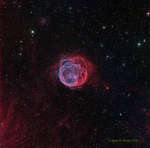 Henize 70: A Superbubble in the LMC
4.02.2019
Massive stars profoundly affect their galactic environments. Churning and mixing interstellar clouds of gas and dust, stars -- most notably those upwards of tens of times the mass of our Sun -- leave their mark on the compositions and locations of future generations of stars.
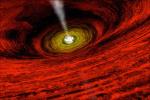 GRO J1655 40: Evidence for a Spinning Black Hole
8.05.2001
In the center of a swirling whirlpool of hot gas is likely a beast that has never been seen directly: a black hole. Studies of the bright light emitted by the swirling gas frequently indicate not only that a black hole is present, but also likely attributes.
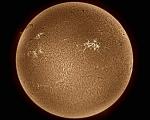 Brown Sun Bubbling
10.01.2000
Our Sun may look like all soft and fluffy, but its not. Our Sun is an extremely large ball of bubbling hot gas, mostly hydrogen gas. The above picture was taken in a specific color of light emitted by hydrogen gas called Hydrogen-alpha.
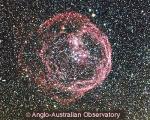 Henize 70: A SuperBubble In The LMC
13.06.1998
Stars with tens of times the mass of the Sun profoundly affect their galactic environment. Churning and mixing the interstellar gas and dust clouds they leave their mark in the compositions and locations of future generations of stars and star systems.
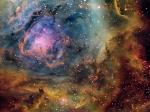 The Busy Center of the Lagoon Nebula
3.08.2005
Stars are battling gas and dust in the Lagoon Nebula but the photographers are winning. Also known as M8, this photogenic nebula is visible even without binoculars towards the constellation of Sagittarius. The energetic processes of star formation create not only the colors but the chaos.
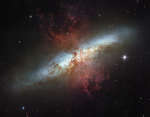 M82: Galaxy with a Supergalactic Wind
19.12.2010
What's lighting up the Cigar Galaxy? M82, as this irregular galaxy is also known, was stirred up by a recent pass near large spiral galaxy M81. This doesn't fully explain the source of the red-glowing outwardly expanding gas, however.
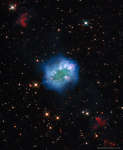 Jets from the Necklace Nebula
18.05.2021
What celestial body wears the Necklace Nebula? First, analyses indicate that the Necklace is a planetary nebula, a gas cloud emitted by a star toward the end of its life. Also, what appears to be diamonds in the Necklace are actually bright knots of glowing gas.
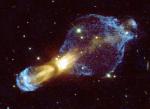 The Making of the Rotten Egg Nebula
3.09.2001
Fast expanding gas clouds mark the end for a central star in the Rotten Egg Nebula. The once-normal star has run out of nuclear fuel, causing the central regions to contract into a white dwarf. Some of the liberated energy causes the outer envelope of the star to expand.
|
January February March April May June July August September |
|||||||||||||||||||||||||||||||||||||||||||||||||