
|
You entered: gas
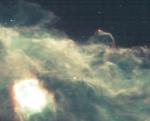 Infrared Horsehead
6.08.1998
This famous cosmic dust cloud was imaged in infrared light by the European Space Agency's Infrared Space Observatory (ISO) satellite. The false-color picture shows the bright infrared emission from dust and molecular gas in part of the Orion star forming region surrounding the Horsehead Nebula.
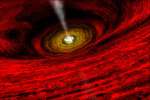 The View Near a Black Hole
23.03.2014
In the center of a swirling whirlpool of hot gas is likely a beast that has never been seen directly: a black hole. Studies of the bright light emitted by the swirling gas frequently indicate not only that a black hole is present, but also likely attributes.
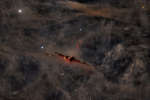 APOD: 2026 July 9 Б The Red Glow of the Cosmic Bat Nebula
9.07.2026
This Cosmic Bat wishes you a happy Summerween! This mid-year celebration of Halloween transcends hemispheres, even though summer in the Northern hemisphere is winter in the South. Contrary to its eery aura, the Cosmic Bat Nebula (LDN 43), not to be confused with the Bat Nebula (NGC 6995), is a vibrant birthplace for stars.
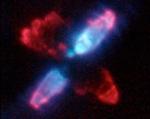 Shells in the Egg Nebula
26.06.1999
The Egg Nebula is taking a beating. Like a baby chick pecking its way out of an egg, the star in the center of the Egg Nebula is casting away shells of gas and dust as it slowly transforms itself into a white dwarf star.
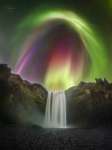 Colorful Aurora over Icenlandic Waterfall
27.08.2026
What a sight to behold, when a night sky became filled with colors that appeared to rain over the Skógafoss waterfall in Iceland. This image was taken in a single 5 second exposure by the photographer in April 2025. Seeing an aurora is on many people's bucket lists.
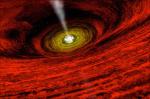 GRO J165540: Evidence for a Spinning Black Hole
26.12.2004
In the center of a swirling whirlpool of hot gas is likely a beast that has never been seen directly: a black hole. Studies of the bright light emitted by the swirling gas frequently indicate not only that a black hole is present, but also likely attributes.
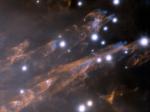 Bullet Pillars in Orion
26.03.2007
Why are bullets of gas shooting out of the Orion Nebula? Nobody is yet sure. First discovered in 1983, each bullet is actually about the size of our Solar System, and moving at about 400 km/sec from a central source dubbed IRc2.
 NGC 1893 and the Tadpoles of IC 410
2.02.2024
This cosmic view shows off an otherwise faint emission nebula IC 410, captured under clear Netherlands skies with telescope and narrowband filters. Above and right of center you can spot two remarkable inhabitants of the interstellar pond of gas and dust, known as the tadpoles of IC 410.
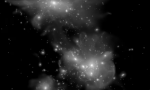 Simulation TNG50: A Galaxy Cluster Forms
26.02.2019
How do clusters of galaxies form? Since our universe moves too slowly to watch, faster-moving computer simulations are created to help find out. A recent effort is TNG50 from IllustrisTNG, an upgrade of the famous Illustris Simulation.
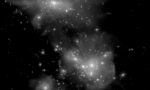 Simulation TNG50: A Galaxy Cluster Forms
29.05.2022
How do clusters of galaxies form? Since our universe moves too slowly to watch, faster-moving computer simulations are created to help find out. A recent effort is TNG50 from IllustrisTNG, an upgrade of the famous Illustris Simulation.
|
January February March April May June July August September |
|||||||||||||||||||||||||||||||||||||||||||||||||