
|
You entered: gas
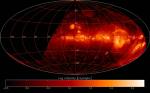 The Southern Sky in Warm Hydrogen
29.01.2002
A robotic telescope with red sunglasses in Chile has been photographing the entire southern sky for years. The result, shown above, is the most complete sky map of the most common visible light emitted from the most abundant element in our Galaxy: hydrogen. A very specific red color emitted by warm ionized hydrogen was observed.
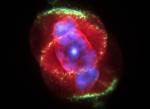 X-rays From The Cat's Eye
11.01.2001
Haunting patterns within planetary nebula NGC 6543 readily suggest its popular moniker -- the Cat's Eye nebula. In 1995, a stunning false-color optical image from the Hubble Space Telescope detailed the swirls of this glowing nebula, known to be the gaseous shroud expelled from a dying sun-like star about 3,000 light-years from Earth.
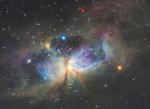 Star Forming Region S106
20.02.2001
Massive star IRS4 is beginning to spread its wings. Born only about 100,000 years ago, material streaming out from this newborn star has formed the nebula dubbed Sharpless 106 Nebula (S106), pictured above.
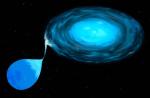 Accretion Disk Binary System
19.12.1999
Our Sun is unusual in that it is alone - most stars occur in multiple or binary systems. In a binary system, the higher mass star will evolve faster and will eventually become a compact object - either a white dwarf star, a neutron star, or black hole.
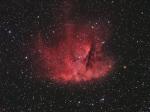 NGC 281: The Pacman Nebula
23.08.2005
NGC 281 is a busy workshop of star formation. Prominent features include a small open cluster of stars, a diffuse red-glowing emission nebula, large lanes of obscuring gas and dust, and dense knots of dust and gas in which stars may still be forming.
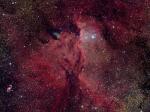 Reflections on NGC 6188
1.06.2006
NGC 6188 is an interstellar carnival of young blue stars, hot red gas, and cool dark dust. Located 4,000 light years away in the disk of our Galaxy, NGC 6188 is home to the Ara OB1 association, a group of bright young stars whose nucleus forms the open cluster NGC 6193.
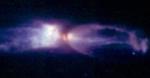 The Rotten Egg Planetary Nebula
1.11.1999
Not all evolving stars eject gas clouds that look like people. OH231.8+4.2 was a star much like our Sun that ran out of nuclear fuel to fuse in its core.
 APOD: 2023 August 14 Б The Ring Nebula from Webb
14.08.2023
The Ring Nebula (M57), is more complicated than it appears through a small telescope. The easily visible central ring is about one light-year across, but this remarkable exposure by the James Webb Space Telescope explores this popular nebula with a deep exposure in infrared light.
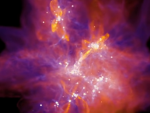 STARFORGE: A Star Formation Simulation
23.06.2021
How do stars form? Most form in giant molecular clouds located in the central disk of a galaxy. The process is started, influenced, and limited by the stellar winds, jets, high energy starlight, and supernova explosions of previously existing stars.
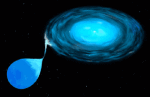 Accretion Disk Binary System
26.12.1995
Our Sun is unusual in that it is alone - most stars occur in multiple or binary systems. In a binary system, the higher mass star will evolve faster and will eventually become a compact object - either a white dwarf star, a neutron star, or black hole.
|
January February March April May |
|||||||||||||||||||||||||||||||||||||||||||||||||