
|
You entered: sky
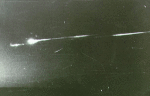 A Meteoric View of Apollo 13
9.07.1995
Meteors, also called shooting stars, normally begin as bits of dust from the tails of comets or even small pieces chipped off asteroids. Falling toward Earth, these particles enter the atmosphere at extremely high speeds. Friction with the air heats them up and makes them glow brightly.
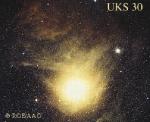 Antares
26.07.1998
Antares is a huge star. In a class called red supergiant, Antares is about 700 times the diameter of our own Sun, 15 times more massive, and 10,000 times brighter. Antares is the brightest star in the constellation of Scorpius and one of the brighter stars in all the night sky.
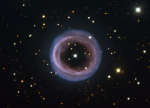 Shapley 1: An Annular Planetary Nebula
16.08.2011
What happens when a star runs out of nuclear fuel? For stars about the mass of our Sun, the center condenses into a white dwarf while the outer atmospheric layers are expelled into space and appear as a planetary nebula.
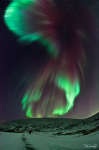 A Memorable Aurora Over Norway
5.12.2011
It was one of the most memorable auroras of the season. There was green light, red light, and sometimes a mixture of the two. There were multiple rays, distinct curtains, and even an auroral corona. It took up so much of the sky.
 Aurora in the Night
31.10.2002
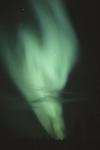
For much of the month of October, traveling shock waves from the Sun and solar wind gusts have buffeted planet Earth's magnetosphere. As a result, skywatchers at high latitudes in the northern hemisphere were treated to many displays of the aurora borealis or northern lights.
 Barnard 228: The Dark Wolf Nebula in Lupus
26.07.2018
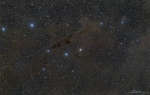
These dark markings on the sky can just be found in silhouette against a rich, luminous background of stars. Seen toward the southern constellation of Lupus the Wolf, the dusty, obscuring clouds are part of the Lupus Molecular Cloud some 500 light-years distant.
 Venus, Moon, and the Smoking Mountain
15.09.2023
Venus has returned as a brilliant morning star. From a window seat on a flight to Mexico City, the bright celestial beacon was captured just before sunrise in this astronomical snapshot, taken on September 12. Venus, at the upper right, shared the early predawn skies with an old crescent Moon.
 Earths Major Telescopes Investigate GRB 130427A
8.05.2013
A tremendous explosion has occurred in the nearby universe and major telescopes across Earth and space are investigating. Dubbed GRB 130427A, the gamma-ray burst was first seen by the Earth-orbiting Swift satellite in high energy X-rays and quickly reported down to Earth.
 100 Steps Forward
15.09.2017
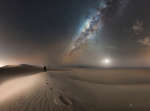
A beautiful conjunction of Venus and Moon, human, sand, and Milky Way is depicted in this night skyscape from planet Earth. The scene is a panorama of 6 photos taken in a moment near the end of a journey.
 The Small Cloud of Magellan (SMC)
25.01.1998
Almost unknown to casual observers in the northern hemisphere, the southern sky contains two diffuse wonders known as the Magellanic Clouds. The Magellanic Clouds are small irregular galaxies orbiting our own larger Milky Way spiral galaxy.
|
January February March April May June July August September October |
|||||||||||||||||||||||||||||||||||||||||||||||||