
|
You entered: sky
 The Dark River to Antares
16.05.2020
A dark river seems to flow through this sky from the horizon toward colorful clouds near red giant star Antares. Murky looking, the dark river is a dusty nebula obscuring background starlight near the central Milky Way, although the dark dust nebula contains mostly hydrogen molecular gas.
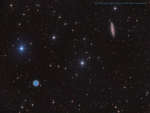 The Owl and the Galaxy
2.04.2015
The Owl and the Galaxy sail these skies With blue and yellow star. They go together beneath the Big Dipper, If you wonder where they are. The Galaxy's light shines through the night, Ten millions of light-years away. But never fear the Owl is near, Inside the Milky Way.
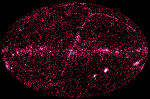 Exploring The Universe With IUE (1978-1996)
30.09.1996
How do planets, stars, and galaxies form? How do they evolve? The International Ultraviolet Explorer (IUE) satellite was launched in 1978 and operated by NASA/ ESA/ PPARC to help provide answers to some of the most fundamental questions about the contents of our universe.
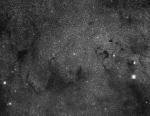 The Snake Nebula in Ophiuchus
11.08.1996
What slithers there? The dark curly lanes visible in part of the constellation Ophiuchus belong to the Snake Nebula. The Snake Nebula is a series of dark absorption clouds. Interstellar dust grains - composed predominantly of carbon - absorb visible starlight and reradiate much of it in the infrared.
 Hypatia of Alexandria
27.01.1999
Sixteen hundred years ago, Hypatia became one of the world's leading scholars in mathematics and astronomy. Hypatia's legendary knowledge, modesty, and public speaking ability flourished during the era of the Great Library of Alexandria.
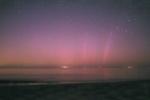 Aurora Over Cape Cod
2.07.2003
Active pillars of colorful aurora were captured dancing over a serenely smooth and nearly colorless Cape Cod Bay last month. North is straight ahead so that the town lights near the center originate from Provincetown, Massachusetts, USA. The unusual red colors in the aurora slightly reflect off the ocean inlet.
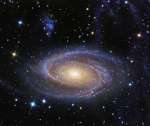 M81 and Arp s Loop
9.12.2010
One of the brightest galaxies in planet Earth's sky and similar in size to the Milky Way, big, beautiful spiral M81 lies 11.8 million light-years away in the northern constellation Ursa Major. This...
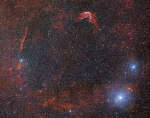 RCW 86: Historical Supernova Remnant
3.03.2023
In 185 AD, Chinese astronomers recorded the appearance of a new star in the Nanmen asterism. That part of the sky is identified with Alpha and Beta Centauri on modern star charts. The new star was visible to the naked-eye for months, and is now thought to be the earliest recorded supernova.
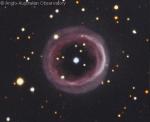 Shapley 1: An Annular Planetary Nebula
25.06.2000
What happens when a star runs out of nuclear fuel? The center condenses into a white dwarf while the outer atmospheric layers are expelled into space and appear as a planetary nebula. This particular planetary nebula, designated Shapley 1 after the famous astronomer Harlow Shapley, has a very apparent annular ring like structure.
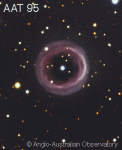 Shapley 1: An Annular Planetary Nebula
15.02.1997
What happens when a star runs out of nuclear fuel? The center condenses into a white dwarf while the outer atmospheric layers are expelled into space and appear as a planetary nebula. This particular planetary nebula, designated Shapley 1 after the famous astronomer Harlow Shapley, has a very apparent annular ring like structure.
|
January February March April May June July August September October |
|||||||||||||||||||||||||||||||||||||||||||||||||