
|
You entered: sky
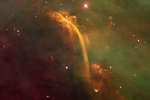 HH 222: The Waterfall Nebula
24.10.2011
What created the Waterfall Nebula? No one knows. The structure seen in the region of NGC 1999 in the Great Orion Molecular Cloud complex is one of the more mysterious structures yet found on the sky. Designated HH-222, the elongated gaseous stream stretches about ten light years and emits an unusual array of colors.
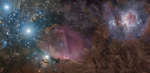 Orion in Gas, Dust, and Stars
12.02.2012
The constellation of Orion holds much more than three stars in a row. A deep exposure shows everything from dark nebula to star clusters, all embedded in an extended patch of gaseous wisps in the greater Orion Molecular Cloud Complex.
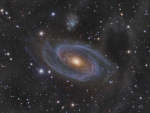 Grand Spiral Galaxy M81 and Arps Loop
16.04.2013
One of the brightest galaxies in planet Earth's sky is similar in size to our Milky Way Galaxy: big, beautiful M81. This grand spiral galaxy lies 11.8 million light-years away toward the northern constellation of the Great Bear (Ursa Major).
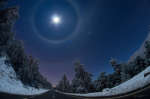 Quadruple Lunar Halo Over Winter Road
1.01.2022
Sometimes falling ice crystals make the atmosphere into a giant lens causing arcs and halos to appear around the Sun or Moon. One Saturday night in 2012 was just such a time near Madrid, Spain, where a winter sky displayed not only a bright Moon but four rare lunar halos.
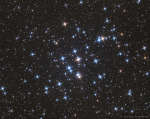 M44: The Beehive Cluster
29.04.2022
A mere 600 light-years away, M44 is one of the closest star clusters to our solar system. Also known as the Praesepe or the Beehive cluster its stars are young though, about 600 million years old compared to our Sun's 4.5 billion years.
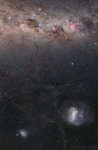 Galaxies and the South Celestial Pole
31.12.2020
The South Celestial Pole is easy to spot in star trail images of the southern sky. The extension of Earth's axis of rotation to the south, it's at the center of all the southern star trail arcs.
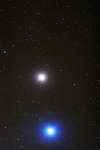 ISON, Mars, Regulus
17.10.2013
In order top to bottom this celestial snapshot features Comet ISON, planet Mars, and Regulus, alpha star of the constellation Leo, in the same frame. The scene spans about 2 degrees near the eastern horizon in early morning skies of October 15.
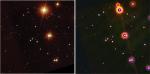 GRB 060218: A Mysterious Transient
26.02.2006
What is it? Something is happening in a small portion of the sky toward the constellation of Aries and telescopes around the globe are tracking an unusual transient there as it changes day by day. No one is sure what it will do next.
 The Mystery of the Fading Star
7.01.2010
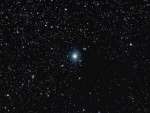
Every 27 years Epsilon Aurigae fades, remaining dim for roughly two years before growing bright again. Since the 19th century, astronomers have studied the mystery star, eventually arguing that Epsilon Aur, centered in this telescopic skyview, was actually undergoing a long eclipse by a dark companion object.
 APOD: 2023 September 20 Б Methane Discovered on Distant Exoplanet
19.09.2023
Where else might life exist? One of humanity's great outstanding questions, locating planets where extrasolar life might survive took a step forward in 2019 with the discovery of a significant amount of water vapor in the atmosphere of distant exoplanet K2-18b.
|
January February March April May June July August September October |
|||||||||||||||||||||||||||||||||||||||||||||||||