
|
You entered: sky
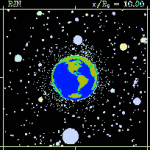 Neutron Star Earth
16.06.1995
If the Earth could somehow be transformed to the ultra-high density of a neutron star , it might appear as it does in the above computer generated figure. Due to the very strong gravitational field, the neutron star distorts light from the background sky greatly. If you look closely, two
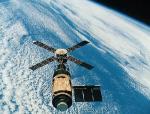 Skylab Over Earth
10.05.1998
Skylab was an orbiting laboratory launched by a Saturn V rocket in May 1973. Skylab was visited three times by NASA astronauts who sometimes stayed as long as two and a half months. Many scientific tests were performed on Skylab, including astronomical observations in ultraviolet and X-ray light.
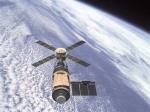 Skylab Over Earth
29.04.2006
Skylab was an orbiting laboratory launched by a in May 1973. Skylab, pictured above, was visited three times by NASA astronauts who sometimes stayed as long as two and a half months. Many scientific tests were performed on Skylab, including astronomical observations in ultraviolet and X-ray light.
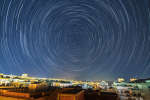 Stars Trail over Ragusa
28.03.2020
In trying times, stars still trail in the night. Taken on March 14, this night skyscape was made by combining 230 exposures each 15 seconds long to follow the stars' circular paths. The camera was fixed to a tripod on an isolated terrace near the center of Ragusa, Italy, on the island of Sicily.
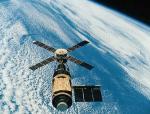 Skylab Over Earth
28.05.2000
Skylab was an orbiting laboratory launched by a Saturn V rocket in May 1973. Skylab was visited three times by NASA astronauts who sometimes stayed as long as two and a half months. Many scientific tests were performed on Skylab, including astronomical observations in ultraviolet and X-ray light.
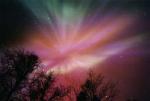 Aurora Above
11.11.1998
On some nights the sky is the most interesting show in town. This picture captures a particularly active and colorful display of aurora that occurred a month ago high above Alaska. Auroras are more commonly seen by observers located near the Earth's poles.
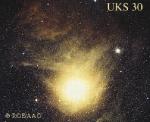 Antares
24.06.1997
Antares is a huge star. In a class called red supergiant, Antares is about 700 times the size of our own Sun, 15 times more massive, and 10,000 times brighter. Antares is the brightest star in the constellation of Scorpius and one of the brighter stars in all the night sky.
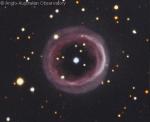 Shapley 1: An Annular Planetary Nebula
9.08.1998
What happens when a star runs out of nuclear fuel? The center condenses into a white dwarf while the outer atmospheric layers are expelled into space and appear as a planetary nebula. This particular planetary nebula, designated Shapley 1 after the famous astronomer Harlow Shapley, has a very apparent annular ring like structure.
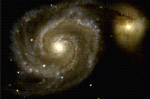 M51: The Whirlpool Galaxy
25.01.1997
The Whirlpool Galaxy is a classic spiral galaxy. At only 15 million light years distant, M51, also cataloged as NGC 5194, is one of the brighter and more picturesque galaxies on the sky.
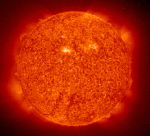 A Winter Solstice
21.12.1997
Today is the Winter Solstice, the shortest day of the year in the Northern Hemisphere. The yearly cycle of Seasons on planet Earth once again finds the Sun at its lowest point in the Northern Sky.
|
January February March April May June July August September October |
|||||||||||||||||||||||||||||||||||||||||||||||||