
|
You entered: sky
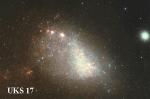 The Small Cloud of Magellan (SMC)
30.04.2000
Almost unknown to casual observers in the northern hemisphere, the southern sky contains two diffuse wonders known as the Magellanic Clouds. The Magellanic Clouds are small irregular galaxies orbiting our own larger Milky Way spiral galaxy.
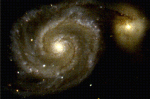 M51: The Whirlpool Galaxy
18.12.1995
The Whirlpool Galaxy is frequently given as an example of a galaxy with classic spiral design. At only 15 million light years distant, M51, also cataloged as NGC 5194, is also one of the brighter and more picturesque galaxies on the sky.
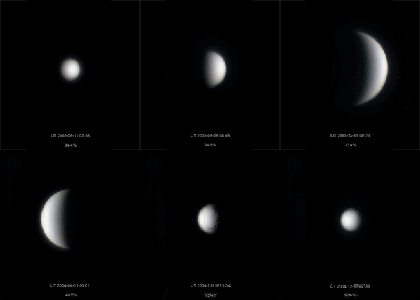 The Phases of Venus
10.01.2006
Venus goes through phases. Just like our Moon, Venus can appear as full as a disk or as a thin as a crescent. Venus, frequently the brightest object in the post-sunset or pre-sunrise sky, appears so small, however, that it usually requires binoculars or a small telescope to clearly see its current phase.
 Eclipse in Seven
11.04.2024
Start at the upper left above and you can follow the progress of April 8's total eclipse of the Sun in seven sharp, separate exposures. The image sequence was recorded with a telescope and camera located within the narrow path of totality as the Moon's shadow swept across Newport, Vermont, USA.
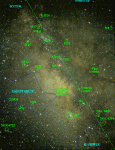 The Annotated Galactic Center
11.11.1997
The sky toward the center of our Galaxy is filled with a wide variety of celestial wonders. Most are visible with only binoculars. Constellations of nearby stars include Sagittarius, Libra, Scorpius, Scutum, and Ophiuchus. Nebulae include Messier Objects M8, M16, M17, M20 and the Pipe Nebula.
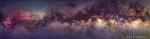 A Milky Way Band
24.02.1999
Most bright stars in our Milky Way Galaxy reside in a disk. Since our Sun also resides in this disk, these stars appear to us as a diffuse band that circles the sky. The above panorama of a southern band of the Milky Way's disk was taken from Australia.
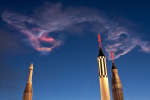 Discovery s Dawn
9.04.2010
On April 5, visitors to Kennedy Space Center saw these colorful clouds, twisting and drifting through dawn skies. Of course, the clouds were rocket engine plumes from the predawn launch of the space shuttle Discovery on the STS-131 mission to the International Space Station.
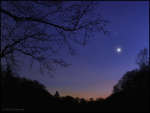 Venus in the West
11.04.2015
In the coming days, Venus shines near the western horizon at sunset. To find Earth's sister planet in twilight skies just look for the brilliant evening star. Tonight very close to the Pleiades...
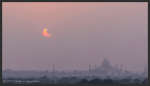 Sunset, Moonset, Taj Mahal
27.10.2022
On October 25th, Sun and New Moon set together as seen from Agra, India. Their close conjunction near the western horizon, a partial solar eclipse, was captured in this elevated view in hazy skies near the solitary dome of the Taj Mahal.
 Meteor over the Bay of Naples
17.02.2024
A cosmic dust grain plowing through the upper atmosphere much faster than a falling leaf created this brilliant meteor streak. In a serendipitous moment, the sublime night sky view was captured from the resort island of Capri, in the Bay of Naples, on the evening of February 8.
|
January February March April May June July August September October |
|||||||||||||||||||||||||||||||||||||||||||||||||