
|
You entered: ESO
 The Century that Defined Galaxy
29.12.1999
As the twentieth century dawned a debate raged over whether the Milky Way was the entire universe. The 1920s brought observations of spiral-nebulae that housed familiar but faint variable stars, and hence placed these nebulae much farther than anything else ever found. The Milky Way, apparently, is itself a spiral nebula seen from the inside.
 A Large Magellanic Cloud Deep Field
9.04.2008
Is this a spiral galaxy? No. Actually, it is the Large Magellanic Cloud (LMC), the largest satellite galaxy of our own Milky Way Galaxy. The LMC is classified as a dwarf irregular galaxy because of its normally chaotic appearance. In this deep and wide exposure, however, the full extent of the LMC becomes visible.
 The Fornax Cluster of Galaxies
10.06.2016
Named for the southern constellation toward which most of its galaxies can be found, the Fornax Cluster is one of the closest clusters of galaxies. About 62 million light-years away, it is almost...
 VLT: A New Largest Optical Telescope
1.09.1996
What is the largest telescope in the world? In the optical, this title was long held by the Hale 200-inch, and is presently held by the Keck telescopes in Hawaii. But an even larger optical telescope is being built.
 Cold Wind From The Boomerang Nebula
15.10.1997
A cold wind blows from the central star of the Boomerang Nebula. Seen here in a false color image of dust reflected starlight, the nebula lies about 5,000 light-years away. The boomerang shaped...
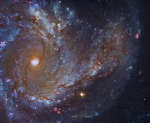 Messier 61 Close Up
27.08.2019
Image data from the Hubble Space Telescope, the European Southern Observatory, and small telescopes on planet Earth are combined in this magnificent portrait of face-on spiral galaxy Messier 61 (M61). A mere 55 million light-years away in the Virgo Cluster of Galaxies, M61 is also known as NGC 4303.
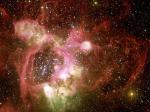 The N44 Emission Nebula
12.02.2006
N44 is one of the largest and most intricate nebulas in this part of the universe. Located in our galactic neighbor the Large Magellanic Cloud, N44 houses numerous massive bright stars, lengthy lanes of dark dust, and vast clouds of hydrogen gas that glows red.
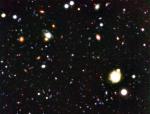 The NTT SUSI Deep Field
15.09.1998
What happens if you point a large telescope at nothing? The above New Technology Telescope SUSI Deep Field photograph isolated a small patch of sky picked to contain no bright objects at all.
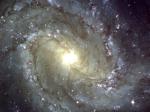 M83: The Southern Pinwheel Galaxy from VLT
17.12.2005
M83 is one of the closest and brightest spiral galaxies on the sky. Visible with binoculars in the constellation of Hydra, majestic spiral arms have prompted its nickname as the Southern Pinwheel. Although discovered...
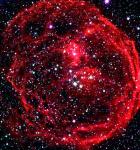 Henize 70: A Superbubble in the LMC
29.11.1999
Massive stars -- upwards of tens of times the mass of the Sun - profoundly affect their galactic environment. Churning and mixing the clouds of gas and dust between the stars, they leave their mark on the compositions and locations of future generations of stars and star systems.
|
January February March April May June July August September |
|||||||||||||||||||||||||||||||||||||||||||||||||