
|
You entered: ESO
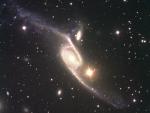 NGC 6872: A Stretched Spiral
25.05.1999
What makes NGC 6872 so long? Measuring over 700,000 light years across from top to bottom, NGC 6872 is one of the largest barred spiral galaxies known. The galaxy's elongated shape might have something to do with its continuing collision with the smaller galaxy IC 4970, visible just above center.
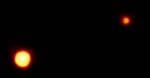 Pluto: The Frozen Planet
13.02.1999
This portrait of Pluto and its companion Charon was taken by the Hubble Space Telescope in 1994. Pluto is usually the most distant planet from the Sun but because of its eccentric orbit Pluto crossed inside of Neptune's orbit in 1979.
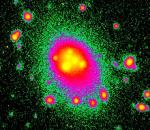 A3827: Cluster Cannibal
31.08.1998
It was mealtime in galaxy cluster Abell 3827. The hungry cluster dominant galaxy in A3827's center is seen being fed. Breakfast included five smaller galaxies unfortunate enough to wander too close to the cluster's central supergiant galaxy. The remnants of these five galaxies can be seen in the center of this false-color picture.
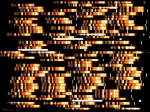 Breaking Distant Light
20.09.2020
In the distant universe, time appears to run slowly. Since time-dilated light appears shifted toward the red end of the spectrum (redshifted), astronomers are able to use cosmological time-slowing to help measure vast distances in the universe.
 Paranal Moonset
4.11.2006
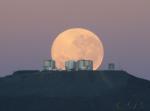
Just before the rising Sun fully illuminated the 2,635 meter summit of Cerro Paranal in northern Chile, Gordon Gillet captured this stunning moonset. In the telephoto picture, a nearly full October Moon is silhouetting the impressive array of telescopes at ESO's Paranal Observatory.
 Comet G3 ATLAS: a Tail and a Telescope
24.01.2025
Comet C/2024 G3 ATLAS has made a dramatic appearance in planet Earth's skies. A visitor from the distant Oort Cloud, the comet reached its perihelion on January 13. On January 19, the bright comet was captured here from ESO Paranal Observatory in the Atacama desert in Chile.
 IC 4628: The Prawn Nebula
23.09.2013
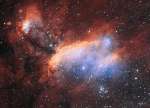
South of Antares, in the tail of the nebula-rich constellation Scorpius, lies emission nebula IC 4628. Nearby hot, massive stars, millions of years young, radiate the nebula with invisible ultraviolet light, stripping electrons from atoms. The electrons eventually recombine with the atoms to produce the visible nebular glow, dominated by the red emission of hydrogen.
 Near Comet Hyakutake's Nucleus
21.03.1996
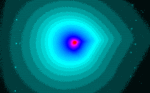
This March 19th false-color picture of Comet Hyakutake from one of the most sophisticated ground based telescopes captures the area surrounding the comet's nucleus. A comet's nucleus - not directly visible here - is a solid dirty iceball probably no more than 10 kilometers across.
 Breaking Distant Light
4.01.2009
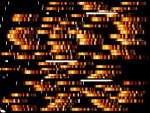
In the distant universe, time appears to run slow. Since time-dilated light appears shifted toward the red end of the spectrum (redshifted), astronomers are able to use cosmological time-slowing to help measure vast distances in the universe.
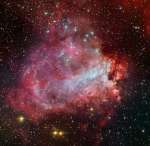 Star Factory Messier 17
22.10.2015
Sculpted by stellar winds and radiation, the star factory known as Messier 17 lies some 5,500 light-years away in the nebula-rich constellation Sagittarius. At that distance, this 1/3 degree wide field of view spans over 30 light-years.
|
January February March April May June July August September |
|||||||||||||||||||||||||||||||||||||||||||||||||