
|
You entered: ESO
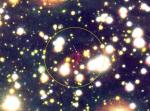 375: Candidate Quark Star
14.04.2002
Why is RJX J185635-375 so cool and so dim? Previously, this compact star held claim to being the closest neutron star -- only 150 light-years away. Now new observations and analysis indicate not only a cool temperature for RXJ J185635-375, pictured above, but also a larger distance: roughly 450 light-years away.
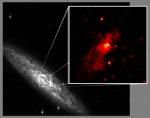 NGC 253: X Ray Zoom
7.06.2001
Astronomers now report that Chandra X-ray Observatory observations of galaxies known to be frantically forming stars show that these galaxies also contain luminous x-ray sources -- thought to be intermediate mass black holes and immense clouds of superheated gas. Take the lovely island universe NGC 253 for example.
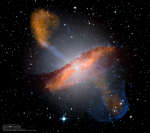 Centaurus As Warped Magnetic Fields
21.04.2021
When galaxies collide -- what happens to their magnetic fields? To help find out, NASA pointed SOFIA, its flying 747, at galactic neighbor Centaurus A to observe the emission of polarized dust -- which traces magnetic fields.
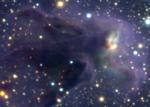 M16: Infrared Star Hunt
4.01.2002
The head of an interstellar gas and dust cloud is shown here in false-color, a near-infrared view recorded by astronomers hunting for stars within M16's Eagle Nebula. Made famous in a 1995 Hubble...
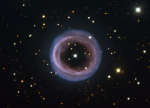 Shapley 1: An Annular Planetary Nebula
16.08.2011
What happens when a star runs out of nuclear fuel? For stars about the mass of our Sun, the center condenses into a white dwarf while the outer atmospheric layers are expelled into space and appear as a planetary nebula.
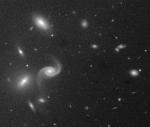 A Peculiar Cluster of Galaxies
29.09.1998
Far across the universe, an unusual cluster of galaxies has been evolving. A diverse group of galaxies populate this cluster, including, on the left, an unusual galaxy showing an equatorial polar ring and a large spiral. Above looms a large elliptical galaxy.
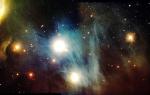 A Chamaeleon Sky
23.03.1999
A photogenic group of nebulae can be found in Chamaeleon, a constellation visible predominantly in skies south of the Earth's equator. Towards Chamaeleon, dark molecular clouds and bright planetary nebula NGC 3195 can be found. Visible near the center of the above photograph is a reflection nebula surrounding a young bright star.
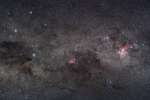 The Southern Cross in a Southern Sky
7.07.2008
This breathtaking patch of sky would be above you were you to stand at the South Pole of the Earth. On the upper left of this image are the four stars that mark the boundaries of the famous Southern Cross.
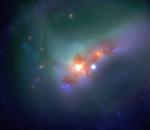 ESO202-G23: Merging Galaxies
1.01.1999
ESO202-G
 Pluto: The Frozen Planet
28.12.1997
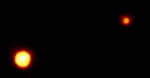
The Hubble Space Telescope imaged Pluto and its moon Charon in 1994. Pluto is usually the most distant planet from the Sun but because of its elliptic orbit Pluto crossed inside of Neptune's orbit in 1979 and will cross back out again in 1999.
|
January February March April May June July August September |
|||||||||||||||||||||||||||||||||||||||||||||||||