
|
You entered: ESO
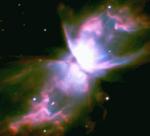 NGC 6302: The Butterfly Nebula
2.06.1998
The Butterfly Nebula is only thousands of years old. As a central star of a binary system aged, it threw off its outer envelopes of gas in a strong stellar wind. The remaining stellar core is so hot it ionizes the previously ejected gas, causing it to glow.
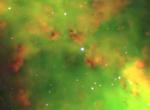 In the Center of the Dumbbell Nebula
13.10.1998
Here's part of the Dumbbell Nebula that you can't see through binoculars. To see this, we suggest a sophisticated spectrograph attached to a telescope with an 8-meter aperture. Pictured above is the central part of the Dumbbell Nebula, also known as M27 and NGC 6853.
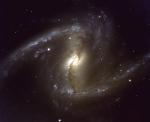 NGC 1365: A Nearby Barred Spiral Galaxy
24.06.1999
Many spiral galaxies have bars across their centers. Even our own Milky Way Galaxy is thought to have a bar, but perhaps not so prominent as the one in NGC 1365, shown above. The persistence and motion of the bar imply relatively massive spiral arms.
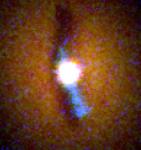 The Center of NGC 6251 is Glowing
12.09.1997
Something is lighting up the center of galaxy NGC 6251. Leading speculation holds that it is a large black hole not shrouded by gas and dust typically found near the center of a galaxy.
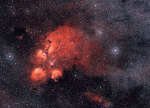 Wide Angle: The Cats Paw Nebula
21.04.2010
Nebulae are perhaps as famous for being identified with familiar shapes as perhaps cats are for getting into trouble. Still, no known cat could have created the vast Cat's Paw Nebula visible in Scorpius.
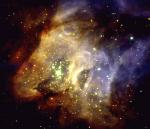 Star Forming Region RCW38
7.12.1998
Star cluster RCW38 was hiding. This open cluster of stars is located about 5000 light years away towards the constellation of Vela. Looking there will not normally reveal most of the stars in this cluster, though.
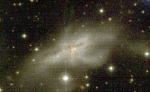 NGC 6240: When Galaxies Collide
28.12.1995
Sometimes even galaxies can suffer a fatal attraction. Here gravity causes two galaxies to collide in a spectacular display of energetic gas, dust, and light. When galaxies collide it is rare that any stars in the galaxies themselves collide, or that any change will be seen in a human lifetime.
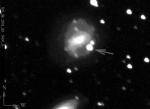 A Gamma Ray Burst Supernova
8.05.1998
Did a gamma-ray burst precede this supernova? This intriguing suggestion came to light yesterday with the discovery of an evolving supernova that is potentially coincident with the position of gamma-ray burst GRB 980425, which occurred just two weeks ago. If true, this would tie together the two most violent phenomena known in the universe.
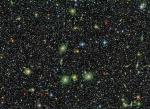 Galaxies Cluster Toward the Great Attractor
4.01.2000
Galaxies dot the sky like jewels in the direction of a mass so large it is known simply as the Great Attractor. The galaxies pictured above are part of a cluster of galaxies called ACO 3627 near the center of the Great Attractor.
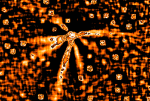 Seven Jets from Comet Hale-Bopp
13.11.1996
Comet Hale-Bopp is turning out to be quite unusual. One reason is the great amount of jet activity at such a large distance from the Sun. In the above false-color image, no less than seven jets can be seen emanating from Hale-Bopp's coma.
|
January February March April May June July August September |
|||||||||||||||||||||||||||||||||||||||||||||||||