
|
You entered: ESO
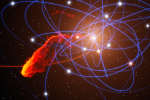 The Diner at the Center of the Galaxy
30.12.2011
The monster at the center of our Galaxy is about to get fed. Recent observations by the Very Large Telescopes indicate that a cloud of gas will venture too close to the supermassive black hole at the Galactic center.
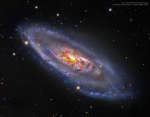 M106: A Spiral Galaxy with a Strange Center
15.02.2015
What's happening at the center of spiral galaxy M106? A swirling disk of stars and gas, M106's appearance is dominated by blue spiral arms and red dust lanes near the nucleus, as shown in the featured image.
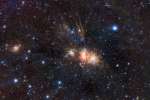 Vista with NGC 2170
15.10.2010
Drifting through the one-horned constellation Monoceros, these dusty streamers and new born stars are part of the active Monoceros R2 star-forming region, embedded in a giant molecular cloud. The cosmic scene was recorded by the VISTA survey telescope in near-infrared light.
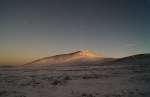 The Snows of Paranal
11.08.2011
Recorded last week, this dawn portrait of snowy mountain and starry sky captures a very rare scenario. The view does feature a pristine sky above the 2,600 meter high mountain Cerro Paranal, but clear skies over Paranal are not at all unusual.
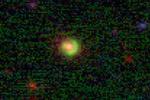 Ring Around the Galaxy
23.12.1998
It is difficult to hide one galaxy far behind another. The closer galaxy's gravity will act like a huge lens, pulling images of the background galaxy around both sides. This is just...
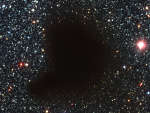 Molecular Cloud Barnard 68
23.03.2008
Where did all the stars go? What used to be considered a hole in the sky is now known to astronomers as a dark molecular cloud. Here, a high concentration of dust and molecular gas absorb practically all the visible light emitted from background stars.
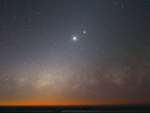 Chilean Skyscape
29.11.2008
Night skies over Chilean mountain top observatories can be dark and clear, with glorious cosmic vistas. In this recent example, the plane of our Milky Way galaxy stretches parallel to the horizon, the galactic center's star clusters, dark dust clouds, and glowing nebulae hovering in the west.
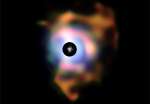 Stardust and Betelgeuse
28.06.2011
An expansive nebula of dust is seen to surround red supergiant star Betegeuse in this remarkable high resolution composite, an infrared VLT image from the European Southern Observatory. Betelgeuse itself is outlined by the small, central red circle. If found in our own solar system its diameter would almost encompass the orbit of Jupiter.
 The Protoplanetary Disk of HL Tauri from ALMA
9.11.2014
Why does this giant disk have gaps? The exciting and probable answer is: planets. A mystery is how planets massive enough to create these gaps formed so quickly, since the HL Tauri star system is only about one million years old.
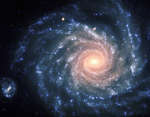 Grand Spiral Galaxy NGC 1232
7.01.2012
Galaxies are fascinating not only for what is visible, but for what is invisible. Grand spiral galaxy NGC 1232, captured in detail by one of the new Very Large Telescopes, is a good example.
|
January February March April May June July August September |
|||||||||||||||||||||||||||||||||||||||||||||||||