
|
You entered: ESO
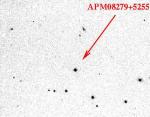 APM 08279+5255: The Brightest Object Yet Known
18.08.1998
It shines with the brightness of 100 billion Suns. Is it a mirage? The recently discovered quasar labeled APM 08279+5255 has set a new record as being the brightest continuously emitting object yet known.
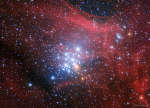 NGC 3293: A Bright Young Star Cluster
5.04.2015
Hot blue stars shine brightly in this beautiful, recently formed galactic or "open" star cluster. Open cluster NGC 3293 is located in the constellation Carina, lies at a distance of about 8000 light years, and has a particularly high abundance of these young bright stars.
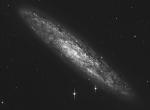 Spiral Galaxy NGC 253
20.01.1999
A camera with over 67 million pixels (digital picture elements) was used to record this stunning image of spiral galaxy NGC 253. Known as the Wide Field Imager (WFI), the camera is the latest instrument to be installed at the European Southern Observatory's 2.2 meter telescope in La Silla, Chile.
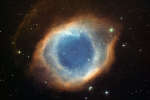 The Helix Nebula from La Silla Observatory
2.03.2009
Will our Sun look like this one day? The Helix Nebula is one of brightest and closest examples of a planetary nebula, a gas cloud created at the end of the life of a Sun-like star.
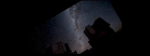 Earth Rotating Under Very Large Telescopes
1.06.2011
Why is the Earth moving in the above video? Most time lapse videos of the night sky show the stars and sky moving above a steady Earth. Here, however, the frames have been digitally rotated so that it is the stars that stay (approximately) steady, and the Earth that moves beneath them.
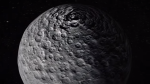 Fly Over Dwarf Planet Ceres
9.06.2015
What would it look like to fly over dwarf planet Ceres? Animators from the German Aerospace Center recently took actual images and height data from NASA's robotic Dawn mission -- currently visiting Ceres -- to generate several fascinating virtual sequences.
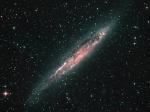 Nearby Spiral Galaxy NGC 4945
12.04.1999
For such a close galaxy, NGC 4945 is easy to miss. NGC 4945 is a spiral galaxy in the Centaurus Group of galaxies, located only six times farther away than the prominent Andromeda Galaxy. The thin disk galaxy is oriented nearly edge-on, however, and shrouded in dark dust.
 APOD: 2025 July 22 Б A Double Detonation Supernova
21.07.2025
Can some supernovas explode twice? Yes, when the first explosion acts like a detonator for the second. This is a leading hypothesis for the cause of supernova remnant (SNR) 0509-67
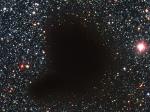 Molecular Cloud Barnard 68
9.04.2006
Where did all the stars go? What used to be considered a hole in the sky is now known to astronomers as a dark molecular cloud. Here, a high concentration of dust and molecular gas absorb practically all the visible light emitted from background stars.
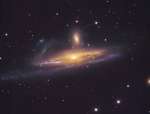 Galaxies in the River
26.11.2008
Large galaxies grow by eating small ones. Even our own galaxy practices galactic cannibalism, absorbing small galaxies that get too close and are captured by the Milky Way's gravity. In fact, the practice...
|
January February March April May June July August September |
|||||||||||||||||||||||||||||||||||||||||||||||||