
|
You entered: Sun
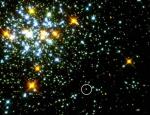 NGC 1818: Pick A Star
15.04.1998
This is NGC 1818, a youthful, glittering cluster of 20,000 stars residing in the Large Magellanic Cloud, 164,000 light-years away. Pick a star. Any star. Astronomers might pick the unassuming bluish-white one (circled) which appears to be a hot newly formed white dwarf star. What makes it so interesting?
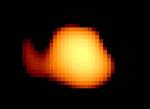 Resolving Mira
11.10.1998
Most stars appear only as points of light. Early last year, Betelgeuse became the second star, after our Sun, to have it surface resolved. Later last year, Mira was added to the list. Mira...
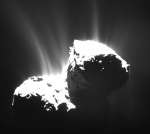 Jets from Comet Churyumov Gerasimenko
2.02.2015
Where do comet tails come from? Although it is common knowledge that comet tails and comas originate from comet nuclei, exactly how that happens is an active topic of research. One of the best...
 APOD: 2025 October 22 Б Comet Lemmon over the High Tatras
22.10.2025
Comet Lemmon putting on a show for cameras around the globe. Passing nearest to the Earth this week, the photogenic comet C/2025 A6 (Lemmon) is now extending two long tails : a blue ion tail and a white dust tail.
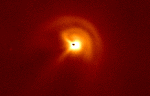 The Rotating Jets of Comet Hyakutake
14.04.1996
Comet Hyakutake will reach its closest point to the Sun on May 1, passing well inside the orbit of Mercury. At this time, the comet's dust and ion tail will be at their greatest physical length.
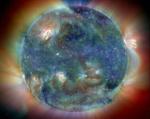 Solstice Celebration
21.12.2002
Aloha and Season's greetings! On December 22nd, at 01:14 Universal Time (December 21, 3:14pm Hawaii-Aleutian Standard Time), the Sun reaches its southernmost point in planet Earth's sky marking the final season change for the year 2002. In celebration, consider this delightfully detailed, brightly colored image of the active Sun.
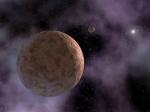 Sedna of the Outer Solar System
16.03.2004
What is the most distant known object in our Solar System? A new answer to this centuries-old question was announced yesterday by NASA with the discovery of a dark red object dubbed Sedna. Although over twice the distance to Pluto, Sedna is near its closest approach to the Sun.
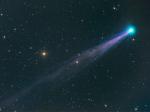 Comet SWAN Brightens
4.10.2006
A newly discovered comet has brightened enough to be visible this week with binoculars. The picturesque comet is already becoming a favored target for northern sky imagers. Pictured above just last week, Comet SWAN showed a bright blue-green coma and an impressive tail.
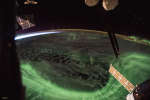 The Aurora and the Sunrise
1.05.2018
On the International Space Station (ISS), you can only admire an aurora until the sun rises. Then the background Earth becomes too bright. Unfortunately, after sunset, the rapid orbit of the ISS around the Earth means that sunrise is usually less than 47 minutes away.
 Planetary Nebula Abell 7
7.03.2025
Very faint planetary nebula Abell 7 is about 1,800 light-years distant. It lies just south of Orion in planet Earth's skies toward the constellation Lepus, The Hare. Surrounded by Milky Way stars...
|
January February March April May |
|||||||||||||||||||||||||||||||||||||||||||||||||