
|
You entered: Sun
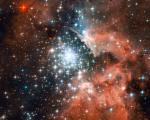 Starburst Cluster in NGC 3603
5.10.2007
A mere 20,000 light-years from the Sun lies NGC 3603, a resident of the nearby Carina spiral arm of our Milky Way Galaxy. NGC 3603 is well known to astronomers as one of the Milky Way's largest star-forming regions.
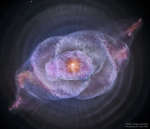 The Cats Eye Nebula in Optical and Xray
1.05.2019
To some it looks like a cat's eye. To others, perhaps like a giant cosmic conch shell. It is actually one of brightest and most highly detailed planetary nebula known, composed of gas expelled in the brief yet glorious phase near the end of life of a Sun-like star.
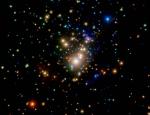 X Ray Stars of Orion
6.10.2007
The stars of Orion shine brightly in visible light in planet Earth's night sky. The constellation harbors the closest large stellar nursery, the Great Nebula of Orion, a mere 1,500 light-years away.
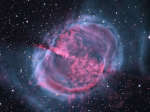 M27: The Dumbbell Nebula
27.12.2011
The first hint of what will become of our Sun was discovered inadvertently in 1764. At that time, Charles Messier was compiling a list of diffuse objects not to be confused with comets.
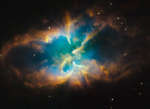 Planetary Nebula NGC 2818 from Hubble
13.07.2014
NGC 2818 is a beautiful planetary nebula, the gaseous shroud of a dying sun-like star. It could well offer a glimpse of the future that awaits our own Sun after spending another 5 billion years or so steadily using up hydrogen at its core, and then finally helium, as fuel for nuclear fusion.
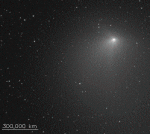 Comet Hale-Bopp Fades
17.09.1996
Comet Hale-Bopp has faded in the past few weeks. For Hale-Bopp, promised as the Great Comet of 1997, this was a bit of a disappointment -- but not entirely unexpected. Comet Hale-Bopp continues to approach...
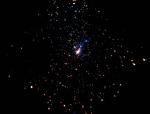 X Ray Stars in the Orion Nebula
19.05.2005
When our middle-aged Sun was just a few million years old it was thousands of times brighter in x-rays. In fact, it was likely similar to some of the stars found in this false-color x-ray composite of the Orion Nebula region from the Chandra Observatory.
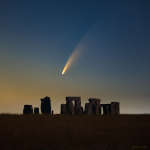 Comet NEOWISE over Stonehenge
14.07.2020
Have you ever seen a comet? Tonight -- and likely the next few nights -- should be a good chance. Go outside just at sunset and look to your northwest. The lower your horizon, the better. Binoculars may help, but if your sky is cloudless and dark, all you should need is your unaided eyes and patience.
 APOD: 2023 December 20 Б Ice Halos over Bavaria
20.12.2023
What's causing those unusual sky arcs? Ice crystals. While crossing a field of fresh snow near Fцssen, Bavaria, Germany, earlier this month, the photographer noticed that he had entered an ice fog.
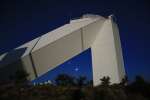 Bright Planets at McMath Pierce Solar Telescope
16.03.2012
Bright planets Venus and Jupiter are framed by the National Solar Observatory's McMath-Pierce Solar Telescope in this very astronomical scene. The photo was taken at Kitt Peak National Observatory on March 9.
|
January February March April May |
|||||||||||||||||||||||||||||||||||||||||||||||||