
|
You entered: Sun
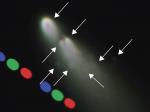 Crumbling Comet Schwassmann Wachmann 3 Approaches
26.04.2006
A crumbling comet will soon pass near the Earth. Comet 73P/Schwassmann-Wachmann 3 is brightening and may even be visible to the unaided eye when the fragmented comet zooms past Earth during the middle of next month.
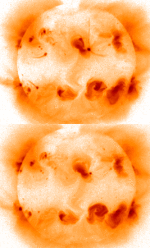 X Ray Triple Jet
31.07.1999
Recorded on July 7, 1998, this animation using X-ray images of the Sun shows an amazing event - three nearly simultaneous jets connected with solar active regions. The two frames were taken several hours apart by the Soft X-ray Telescope on board the orbiting Yohkoh observatory.
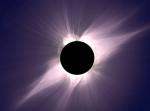 Solar Surfin
16.07.1999
The sun's corona is a tenuous outer atmosphere composed of streams of energetic charged particles, but it is only easily seen from Earth during a total solar eclipse. For example, this 1991 image of totality from atop Mauna Kea, Hawaii forms a fleeting snapshot of the mysterious corona's beautiful, intricate structures and streams.
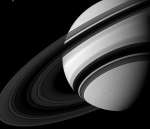 Saturns Rings from the Dark Side
31.12.2012
What do Saturn's rings look like from the dark side? From Earth, we usually see Saturn's rings from the same side of the ring plane that the Sun illuminates them -- one might call this the bright side.
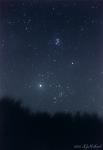 September Sky
29.09.2000
Star clusters, planets, and a red giant posed for this portrait of the night sky from rural Jasper County, Iowa, USA. Astrophotographer Stan Richard recorded the four minute time exposure looking east around midnight on September 3rd at Ashton-Wildwood Park.
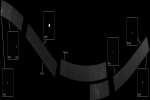 The Solar System from MESSENGER
23.02.2011
If you looked out from the center of the Solar System, what would you see? Nearly such a view was taken recently from the MESSENGER spacecraft currently orbiting the Sun from the distance of Mercury. The Sun's planets all appear as points of light, with the closest and largest planets appearing the brightest.
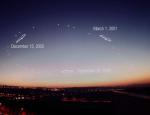 Venus Evening Loop
1.06.2001
From September 2000 through March 2001, astronomer Tunc Tezel patiently photographed the planet Venus on 25 different dates as it wandered through the evening twilight. The pictures were taken from the same spot...
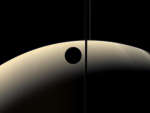 Crescent Rhea Occults Crescent Saturn
20.07.2008
Soft hues, partially lit orbs, a thin trace of the ring, and slight shadows highlight this understated view of the majestic surroundings of the giant planet Saturn. Looking nearly back toward the Sun, the robot Cassini spacecraft now orbiting Saturn captured crescent phases of Saturn and its moon Rhea in color a few years ago.
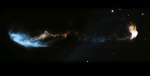 HH 47: A Young Star Jet Expands
5.09.2011
Stars remain where they are. Nebulas appear the same. Day after day. Year after year. Given the vast distances in astronomy, even fast moving objects will not appear to change their appearance in a human lifetime. Typically. A recent spectacular exception to this, however, is the supersonic jet in the star forming Herbig Haro 47.
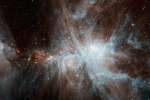 Spitzer's Orion
31.08.2019
Few cosmic vistas excite the imagination like the Orion Nebula, an immense stellar nursery some 1,500 light-years away. Spanning about 40 light-years across the region, this infrared image from the Spitzer Space Telescope...
|
January February March April May |
|||||||||||||||||||||||||||||||||||||||||||||||||