
|
You entered: Sun
 APOD: 2024 May 11 Б AR 3664: Giant Sunspot Group
11.05.2024
Right now, one of the largest sunspot groups in recent history is crossing the Sun. Active Region 3664 is not only big -- it's violent, throwing off clouds of particles into the Solar System. Some of these CMEs are already impacting the Earth, and others might follow.
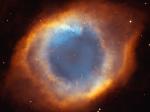 NGC 7293: The Helix Nebula
10.05.2003
Will our Sun look like this one day? The Helix Nebula is the closest example of a planetary nebula created at the end of the life of a Sun-like star. The outer gasses of the star expelled into space appear from our vantage point as if we are looking down a helix.
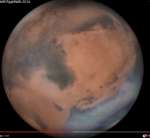 Mars at Closest Approach 2016
9.08.2016
When does Mars appear the largest? This occurs when Earth sweeps past Mars in their respective orbits around the Sun, creating a momentary Sun-Earth-Mars alignment called opposition. The featured video shows the Mars opposition that occurred earlier this year. All of the images were taken from Earth with a small telescope.
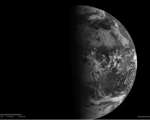 Equinox on a Spinning Earth
19.03.2017
When does the line between day and night become vertical? Tomorrow. Tomorrow is an equinox on planet Earth, a time of year when day and night are most nearly equal. At an equinox, the Earth's terminator -- the dividing line between day and night -- becomes vertical and connects the north and south poles.
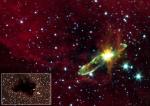 Young Star, Dark Cloud
26.12.2003
High-speed outflows of molecular gas from a young stellar object glow in infrared light, revealing themselves in this recent false-color image from the Spitzer Space Telescope. Cataloged as HH (Herbig-Haro) 46/47 the infrared source...
 An Aurora Before the Storm
19.05.2000
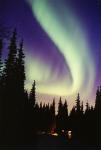
Early April brought some of the most intense auroral storms this decade. An aurora on April 6 was reported to be the largest visible on Earth since 1989, and was seen throughout Europe and much of northern North America.
 Four X-class Flares
16.05.2013
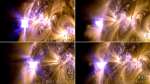
Swinging around the Sun's eastern limb on Monday, a group of sunspots labeled active region AR1748 has produced the first four X-class solar flares of 2013 in less than 48 hours. In time sequence clockwise from the top left, flashes from the four were captured in extreme ultraviolet images from the Solar Dynamics Observatory.
 Mercury Visualized from MESSENGER
11.12.2017
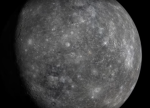
What would it be like to fly over the planet Mercury? Images and data taken from NASA's robotic MESSENGER spacecraft that orbited Mercury from 2011 to 2015 have been digitally combined to envision a virtual flight that highlights much of the hot planet's surface.
 Venus: Earth's Cloudy Twin
23.09.1996
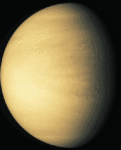
If Venus weren't so cloudy it would be more similar to Earth. This picture by the Galileo spacecraft shows just how cloudy Venus is. Venus is very similar to Earth in size and mass - and so is sometimes referred to as Earth's sister planet - but Venus has a quite different climate.
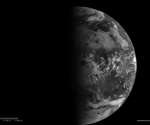 Equinox on a Spinning Earth
19.03.2014
When does the line between day and night become vertical? Tomorrow. Tomorrow is an equinox on planet Earth, a time of year when day and night are most nearly equal. At an equinox, the Earth's terminator -- the dividing line between day and night -- becomes vertical and connects the north and south poles.
|
January February March April May |
|||||||||||||||||||||||||||||||||||||||||||||||||