
|
You entered: Sun
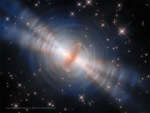 APOD: 2026 February 25 Б The Egg Nebula from the Hubble Telescope
25.02.2026
Ever wonder what it would look like to crack open the Sun? The Egg Nebula, a dying Sun-like star, can unscramble this question. Pictured is a combination of several visible and infrared images of the nebula (also known as RAFGL 2688 or CRL 2688) taken with the Hubble Space Telescope.
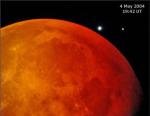 Zubenelgenubi and Friends
14.05.2004
Moderately bright Zubenelgenubi is the star just off the upper right hand limb of an eclipsed Moon in this telescopic view from Port Elizabeth, South Africa. Actually the second brightest star in the constellation...
 Solar Eclipse in View
7.04.2005
Friday's solar eclipse will be a rare hybrid - briefly appearing as either an annular eclipse or a total eclipse when viewed from along the narrow track of the Moon's shadow. Unfortunately that...
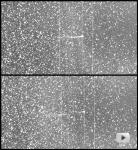 Comet Encke s Tail Ripped off
3.10.2007
Swinging inside the orbit of Mercury, on April 20th periodic comet Encke encountered a blast from the Sun in the form of a Coronal Mass Ejection (CME). When CMEs, enormous clouds of energetic particles ejected from the Sun, slam into Earth's magnetosphere, they often trigger auroral displays.
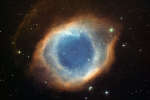 The Helix Nebula from La Silla Observatory
3.03.2009
Will our Sun look like this one day? The Helix Nebula is one of brightest and closest examples of a planetary nebula, a gas cloud created at the end of the life of a Sun-like star.
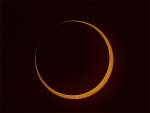 Cape York Annular Eclipse
11.05.2013
This week the shadow of the New Moon fell on planet Earth, crossing Queensland's Cape York in northern Australia ... for the second time in six months. On the morning...
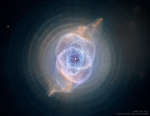 The Cats Eye Nebula from Hubble
10.06.2018
To some, it may look like a cat's eye. The alluring Cat's Eye nebula, however, lies three thousand light-years from Earth across interstellar space. A classic planetary nebula, the Cat's Eye (NGC 6543) represents a final, brief yet glorious phase in the life of a sun-like star.
 A Blue Hour Full Moon
26.08.2021
Nature photographers and other fans of planet Earth always look forward to the blue hour. That's the transition in twilight, just before sunrise or after sunset, when the Sun is below the horizon but land and sky are still suffused with a beautiful blue light.
 The Solar Eclipse Analemma Project
20.03.2025
Recorded from 2024 March 10, to 2025 March 1, this composited series of images reveals a pattern in the seasonal drift of the Sun's daily motion through planet Earth's sky. Known...
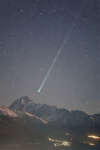 APOD: 2026 April 12 Б Comet R3 PanSTARRS Brightens
12.04.2026
Comet R3 is brightening rapidly -- will it survive? C/2025 R3 (PanSTARRS) has been slowly brightening and extending an ion tail since its discovery last year. This shedding mountain of dirty ice puts...
|
January February March April May |
|||||||||||||||||||||||||||||||||||||||||||||||||