
|
You entered: Sun
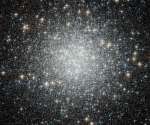 Blue Straggler Stars in Globular Cluster M53
9.04.2012
If our Sun were part of M53, the night sky would glow like a jewel box of bright stars. M53, also known as NGC 5024, is one of about 250 globular clusters that survive in our Galaxy.
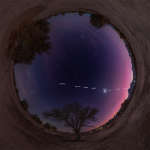 Solar System Family Portrait
29.06.2022
Yes, but have you ever seen all of the planets at once? A rare roll-call of planets has been occurring in the morning sky for much of June. The featured fisheye all-sky image, taken...
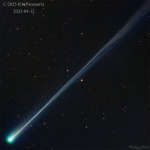 APOD: 2026 April 14 Б The Long Wispy Tail of Comet R3 (PanSTARRS)
14.04.2026
Why does Comet R3 (PanSTARRS) have a wispy tail? The newest bright member of the inner Solar System, Comet C/2025 R3 (PanSTARRS) is already extending an impressive stream of glowing gas. This tail starts from an unseen central nucleus of dirty ice that is likely a few kilometers across.
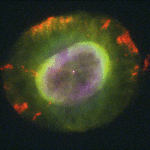 The Blue Snowball Planetary Nebula
21.11.1996
Will the Sun one day look like - a blue snowball? Maybe! The Blue Snowball is a planetary nebula - and in 5 billion years the Sun will throw off its outer layers and go through a planetary nebula phase.
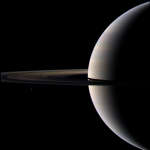 Saturn After Equinox
10.11.2009
The other side of Saturn's ring plane is now directly illuminated by the Sun. For the previous 15 years, the southern side of Saturn and its rings were directly illuminated, but since Saturn's equinox in August, the orientation has reversed.
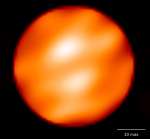 The Spotty Surface of Betelgeuse
6.01.2010
Betelgeuse really is a big star. If placed at the center of our Solar System it would extend to the orbit of Jupiter. But like all stars except the Sun, Betelgeuse is so distant it usually appears as a single point of light, even in large telescopes.
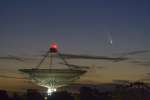 PanSTARRS over Parkes
9.03.2013
Sweeping quickly through southern skies on March 5, Comet PanSTARRS (C/2011 L4) follows the Sun toward the western horizon in this twilight scene. In the foreground is Australia's CSIRO Parkes Radio Telescope, a 64 meter wide steerable dish that is no stranger to the space age exploration of comets.
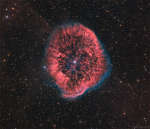 APOD: 2023 February 8 Б Stellar Wind Shaped Nebula RCW 58
8.02.2023
Imagine traveling to a star about 100 times as massive as our Sun, a million times more luminous, and with 30 times the surface temperature. Such stars exist, and some are known as Wolf Rayet (WR) stars, named after French astronomers Charles Wolf and Georges Rayet.
 APOD: 2023 April 25 Б Northern Lights over Southern Europe
25.04.2023
Did you see an aurora over the past two nights? Many people who don't live in Earth's far north did. Reports of aurora came in not only from northern locales in the USA as Alaska, but as far south as Texas and Arizona. A huge auroral oval extended over Europe and Asia, too.
 A Season of Saturn
25.08.2023
Ringed planet Saturn will be at its 2023 opposition, opposite the Sun in Earth's skies, on August 27. While that puts the sixth planet from the Sun at its brightest and well-placed for viewing, its beautiful ring system isn't visible to the unaided eye.
|
January February March April May |
|||||||||||||||||||||||||||||||||||||||||||||||||