
|
You entered: ion
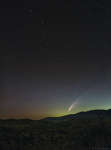 Finding NEOWISE
18.07.2020
If you can see the stars of the Big Dipper, you can find comet NEOWISE in your evening sky tonight. After sunset look for the naked-eye comet below the bowl of the famous celestial kitchen utensil of the north and above your northwestern horizon.
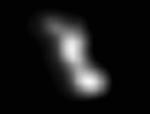 Asteroid 9969 Braille
5.08.1999
NASA probe Deep Space 1 zoomed past asteroid 9969 Braille last week as it continued to test its new ion drive in the inner Solar System. The flyby was the closest approach a spacecraft has ever made to an asteroid. Looking back afterwards, DS1 took the above picture.
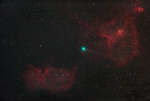 Comet Jacques, Heart and Soul
22.08.2014
On July 13th, a good place to watch Comet Jacques was from Venus. Then, the recently discovered visitor (C/2014 E2) to the inner solar system passed within about 14.5 million kilometers of our sister planet.
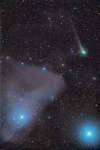 Stardust and Comet Tails
20.08.2022
Heading for its closest approach to the Sun, or perihelion, on December 19 comet C/2017 K2 (PanSTARRS) remains a sight for telescopic observers as it sweeps through planet Earth's skies in the constellation Scorpius.
 Comet Meets Moon and Morning Star
12.12.2015
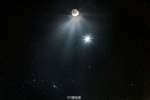
A crescent Moon and brilliant Venus met in predawn skies on December 7, a beautiful conjunction of planet Earth's two brightest celestial beacons after the Sun. Harder to see but also on the scene was Comet Catalina (C/2013 US10).
 Unexpected Comet Pojmanski Now Visible
6.03.2006
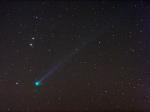
Have you ever seen a comet? Comets bright enough to be visible to the unaided eye appear only every few years. Right now, however, a new comet has brightened unexpectedly and is visible as a faint streak to the unaided northern observer in the eastern morning sky just before sunrise. Binoculars may help.
 Red Auroral Corona
15.01.2002
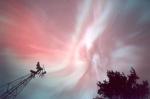
Few auroras show this level of detail. This unusual display of an auroral corona occurred on Earth three days after an unusual solar event -- the fifth most powerful explosion yet recorded on the Sun. An X14-class solar flare on April 15 sent a tremendous Coronal Mass Ejection (CME) into the Solar System.
 SMART 1: Pythagoras Crater
3.02.2005
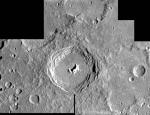
Stark shadows show off the central peaks and terraced walls of 120 kilometer wide Pythagoras Crater in this mosaic of images from ESA's SMART-1 spacecraft. Characteristic of large, complex impact craters on the Moon, the central uplift was produced by a rebound of the suddenly molten lunar crust during the violent impact event.
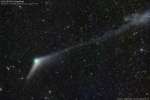 Comet Catalina Tails
1.01.2016
A new year's treat for binoculars, as 2016 begins Comet Catalina (C/2013 US10) now sweeps through planet Earth's predawn skies near bright Arcturus, alpha star of Bootes. But this telescopic mosaic from December 21 follows the pretty tails of the comet across a field of view as wide as 10 full moons.
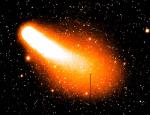 Comet Linear (WM1) Brightens
6.12.2001
A comet bright enough to be seen with binoculars is swooping into southern skies. Comet C/2000 WM1 (LINEAR) continues to brighten and develop tails as it nears its closest approach of the Sun in late January 2002.
|
January February |
|||||||||||||||||||||||||||||||||||||||||||||||||