
|
You entered: ion
 Eagle Aurora over Norway
22.10.2016
What's that in the sky? An aurora. A large coronal mass ejection occurred on our Sun five days before this 2012 image was taken, throwing a cloud of fast moving electrons, protons, and ions toward the Earth.
 Periodic Comet Swift Tuttle
7.08.2024
A Halley-type comet with an orbital period of about 133 years, Comet 109P/Swift-Tuttle is recognized as the parent of the annual Perseid Meteor Shower. The comet's last visit to the inner Solar System was in 1992.
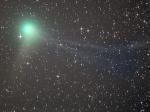 Announcing Comet Machholz
12.12.2004
A comet discovered only this summer is brightening quickly and already visible to the unaided eye. Comet C/2004 Q2 (Machholz) is currently best visible in Earth's Southern Hemisphere where some observers report it brighter than magnitude 5. The comet is moving rapidly to northern skies and should continue to brighten until early January.
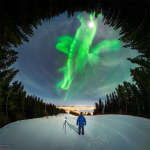 A Whale of an Aurora over Swedish Forest
21.03.2022
What's that in the sky? An aurora. A large coronal mass ejection occurred on our Sun earlier this month, throwing a cloud of fast-moving electrons, protons, and ions toward the Earth. Part...
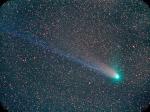 The Tails of Comet NEAT Q4
12.05.2004
Comet NEAT (Q4) is showing its tails. As the large snowball officially dubbed Comet C/2001 Q4 (NEAT) falls toward the inner Solar System, it has already passed the Earth and will reach its closest approach to the Sun this coming Saturday.
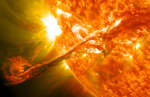 A Solar Filament Erupts
17.09.2012
What's happened to our Sun? Nothing very unusual -- it just threw a filament. At the end of last month, a long standing solar filament suddenly erupted into space producing an energetic Coronal Mass Ejection (CME).
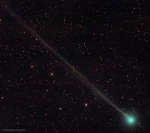 Comet 45P Returns
1.01.2017
An old comet has returned to the inner Solar System. Not only is Comet 45P/HondaMrkosPajduАkovА physically ancient, it was first discovered 13 orbits ago in 1948. Comet 45P spends most of its time out near the orbit of Jupiter and last neared the Sun in 2011.
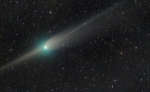 Comet ZTF: Orbital Plane Crossing
26.01.2023
The current darling of the northern night, Comet C/2022 E3 ZTF is captured in this telescopic image from a dark sky location at June Lake, California. Of course Comet ZTF has been growing brighter in recent days, headed for its closest approach to Earth on February 1.
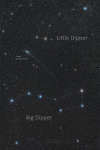 APOD: 2023 February 7 Б A Comet and Two Dippers
6.02.2023
Can you still see the comet? Yes. Even as C/2022 E3 (ZTF) fades, there is still time to see it if you know where and when to look. Geometrically, Comet ZTF has passed its closest to both the Sun and the Earth and is now headed back to the outer Solar System.
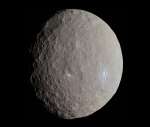 Dwarf Planet Ceres
3.02.2016
Dwarf planet Ceres is the largest object in the Solar System's main asteroid belt, with a diameter of about 950 kilometers (590 miles). Ceres is seen here in approximately true color, based on image data from the Dawn spacecraft recorded on May 4, 2015.
|
January February |
|||||||||||||||||||||||||||||||||||||||||||||||||