
|
You entered: ion
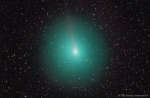 Comet 45P Passes Near the Earth
12.02.2017
A large snowball has just passed the Earth. Known as Comet 45P/HondaMrkosPajduАkovА", or 45P for short, the comet came 10 times closer to Earth yesterday than the Earth ever gets to the Sun. During this passage, the comet was photographed sporting a thin ion tail and a faint but expansive green coma.
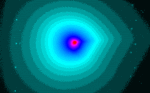 Near Comet Hyakutake's Nucleus
21.03.1996
This March 19th false-color picture of Comet Hyakutake from one of the most sophisticated ground based telescopes captures the area surrounding the comet's nucleus. A comet's nucleus - not directly visible here - is a solid dirty iceball probably no more than 10 kilometers across.
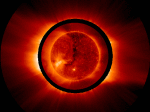 A Wind From The Sun
17.02.1997
A wind from the Sun blows through our Solar System. The behaviour of comet tails as they flapped and waved in this interplanetary breeze gave astronomers the first hint of its existence. Streaming outward...
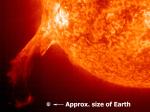 An Erupting Solar Prominence from SOHO
7.08.2006
Our Sun is still very active. In the year 2000, our Sun went though Solar Maximum, the time in its 11-year cycle where the most sunspots and explosive activities occur. Sunspots, the Solar Cycle, and solar prominences are all caused by the Sun's changing magnetic field.
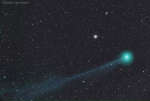 Comet Lovejoy before a Globular Star Cluster
30.12.2014
Comet Lovejoy has become visible to the unaided eye. To see the comet, just go outside an hour or so after sunset and look for a fuzzy patch to the right of Orion's belt. Binoculars and a star chart may help.
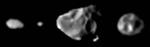 Jupiter's Inner Moons
27.11.1997
The potato-shaped inner moons of Jupiter are lined-up in this mosaic "family portrait" of these tiny Jovian satellites. The individual images were recorded over the last year by NASA's Galileo spacecraft and are scaled to the moons' relative sizes.
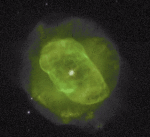 NGC 5882: A Small Planetary Nebula
28.08.1996
Will most stars one day look like this? Pictured above is the planetary nebula NGC 5882, captured by the Hubble Space Telescope. Although planetary nebulae can appear similar to planets like Uranus and Neptune, they are actually gas clouds surrounding stars typically hundreds of light years away.
 Comet NEAT (Q4) Over Indian Cove
18.05.2004
Comet NEAT (Q4) was quite photogenic earlier this month. Although the head and part of the tails of Comet C/2001 Q4 (NEAT) were visible to the unaided eye, the best views of the colorful tail were revealed only later by cameras able to expose for long periods.
 January Aurora Over Norway
24.01.2012
What's that in the sky? An aurora. A large coronal mass ejection occurred on our Sun five days ago, throwing a cloud of fast moving electrons, protons, and ions toward the Earth. Although...
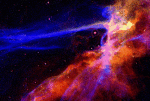 Rampaging Fronts of the Veil Nebula
7.03.1996
A supernova explosion of a high-mass star results in fast moving blast waves. At the front of the waves shown above, ionized gas in the Veil Supernova Remnant rushes out from the explosion, sweeps up material, and breaks up many atoms into constituent ions and electrons.
|
January February |
|||||||||||||||||||||||||||||||||||||||||||||||||