
|
You entered: ion
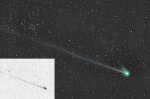 Comet McNaught Passes NGC 1245
17.06.2010
Of the many comets named for discoverer Robert McNaught, the one cataloged as C/2009 R1 is gracing dawn skies for northern hemisphere observers this month. Seen here on June 13th from southern New Mexico, this Comet McNaught's long ion tail sweeps across the telescopic field of view (a negative image is inset).
 APOD: 2024 January 3 Б A SAR Arc from New Zealand
3.01.2024
What is that unusual red halo surrounding this aurora? It is a Stable Auroral Red (SAR) arc. SAR arcs are rare and have only been acknowledged and studied since 1954. The featured wide-angle photograph...
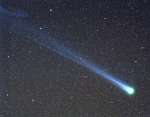 Comet Hyakutake Passes the Earth
16.12.2009
In 1996, an unexpectedly bright comet passed by planet Earth. Discovered less than two months before, Comet C/1996 B2 Hyakutake came within only 1/10th of the Earth-Sun distance from the Earth in late March.
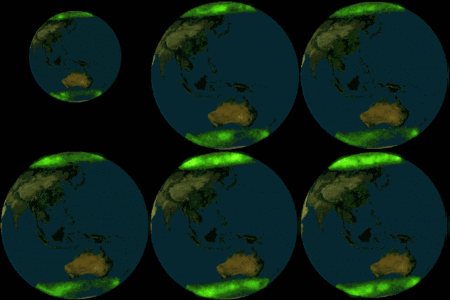 Auroras Over Both Earth Poles
14.11.2001
Auroras in the north and south can be nearly mirror images of each other. Such mirroring had been suspected for centuries but dramatically confirmed only last month by detailed images from NASA's orbiting Polar spacecraft.
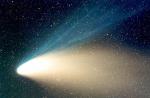 A Star Cluster Through Hale-Bopp's Tail
16.04.1997
Comet Hale-Bopp continues to look impressive. The photograph above captured the comet on April 7th passing nearly in front of M34, a star cluster in the constellation of Perseus. Many of the stars in this open cluster can be seen through Comet Hale-Bopp's white dust tail.
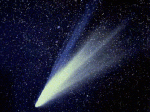 Two Tails of Comet West
26.08.1995
Here Comet West is seen showing two enormous tails that wrap around the sky. The ion tale of a comet usually appears more blue and always points away from the Sun. The dust tail trailing the comet's nucleus is the most prominent.
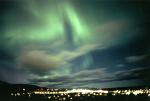 A Yukon Aurora
8.10.2001
Last week was another good week for auroras. The story began about two weeks ago when two large Coronal Mass Ejections exploded off the Sun. Waves of elementary particles and ions swept out past the Earth on September 28 and 29, causing many auroras.
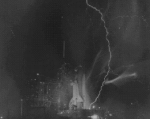 Lightning and the Space Shuttle
10.11.1995
There are many things about lightning that are not understood. Lightning has been seen in the atmospheres of Venus, Earth, Jupiter, and Saturn. A leading theory is that collisions of particles in clouds cause large areas of positive and negative charge.
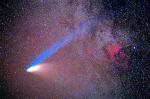 Hale Bopp and the North American Nebula
9.10.1997
Comet Hale-Bopp's recent encounter with the inner Solar System allowed many breath-taking pictures. Above, Comet Hale-Bopp was photographed on March 8th in the constellation of Cygnus. Visible on the right in red is the North American Nebula, a bright emission nebula observable from a dark location with binoculars.
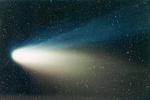 Comet Hale-Bopp's Developing Tail
14.03.1997
Comet Hale-Bopp is living up to its expectations. Besides the brightness of its coma, a comet is typically remembered by the length of its tails. As visible in the above picture taken last week, Comet Hale-Bopp's blue ion tail shows a dramatic extension, with current reports of about 20 degrees from dark locations.
|
January February |
|||||||||||||||||||||||||||||||||||||||||||||||||