
|
You entered: ion
 APOD: 2025 November 17 Б Comet Lemmons Wandering Tail
17.11.2025
What has happened to Comet Lemmon's tail? The answer is blowing in the wind Б the wind from the Sun in this case. This continuous outflow of charged particles from...
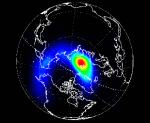 X-Ray Earth
30.12.1996
The Earth glows in many kinds of light, including the energetic X-ray band. Actually, the Earth itself does not glow - only aurora produced high in the Earth's atmosphere. Above is the first picture of the Earth in X-rays, taken in March with the orbiting Polar satellite. Bright X-ray emission is shown in red.
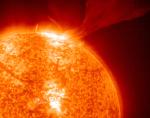 A Solar Prominence Erupts
24.09.2001
Our Sun is still very active. Last year, our Sun went though Solar Maximum, the time in its 11-year cycle where the most sunspots and explosive activities occur. Sunspots, the Solar Cycle, and solar prominences are all caused by the Sun's changing magnetic field.
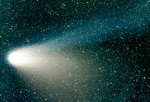 Comet Hale-Bopp Enters the Evening Sky
7.03.1997
You no longer have to wake-up early to see Comet Hale-Bopp. From many northern locations, you can now go outside just after sunset and see Comet Hale-Bopp above the north-western horizon. Both writer/editors of APOD are impressed by how bright Comet Hale-Bopp has become, and how easily visible it is.
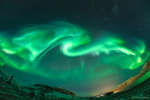 Dragon Aurora over Norway
10.04.2018
What's that in the sky? An aurora. A large coronal hole opened last month, a few days before this image was taken, throwing a cloud of fast moving electrons, protons, and ions toward the Earth.
 Comet 13P Olbers
28.06.2024
Not a paradox, Comet 13P/Olbers is returning to the inner Solar System after 68 years. The periodic, Halley-type comet will reach its next perihelion or closest approach to the Sun on June 30 and has become a target for binocular viewing low in planet Earth's northern hemisphere night skies.
 Comet Pons-Brooks at Night
4.04.2024
In dark evening skies over June Lake, northern hemisphere, planet Earth, Comet 12P/Pons-Brooks stood just above the western horizon on March 30. Its twisted turbulent ion tail and diffuse greenish coma are captured in this two degree wide telescopic field of view along with bright yellowish star Hamal also known as Alpha Arietis.
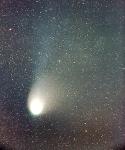 Comet Hale-Bopp Returns
6.02.1997
Comet Hale-Bopp has returned from behind the Sun. In December and early January, Comet Hale-Bopp was too near the Sun to be easily visible from Earth. Now the comet graces the morning sky and is visible from dark locations even without binoculars.
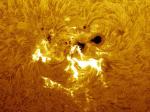 A Large Active Region Crosses the Sun
26.07.2004
An unexpectedly large sunspot region is now crossing the Sun. The active region is home to rivers of hot plasma, explosive flares, strong magnetic fields, a powerful Coronal Mass Ejection (CME), and a sunspot group so large it can be seen by the protected eye without magnification.
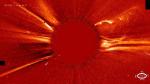 Red Sun Streaming
7.01.1997
The Sun is leaking. In fact, it is gushing: particles stream away from the Sun at hundreds of kilometers per second. Some of these particles strike the Earth and cause aurora. Most particles, however, either surround the Sun as a huge solar corona or glide into interstellar space as the solar wind.
|
January February |
|||||||||||||||||||||||||||||||||||||||||||||||||