
|
You entered: orbit
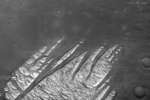 White Rock Fingers on Mars
15.02.2016
What caused this unusual light rock formation on Mars? Intrigued by the possibility that they could be salt deposits left over as an ancient lakebed dried-up, detailed studies of these fingers now indicate a more mundane possibility: volcanic ash. Studying the exact color of the formation indicated the possible volcanic origin.
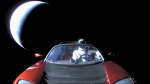 Roadster, Starman, Planet Earth
10.02.2018
Don't panic. It's just a spacesuited mannequin named Starman. As the sunlit crescent of planet Earth recedes in the background, Starman is comfortably seated at the wheel of a Tesla Roadster in this final image of the payload launched by a Falcon Heavy rocket on February 6.
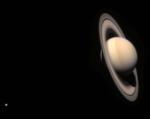 Cassini Approaches Saturn
4.11.2002
Cassini, a robot spacecraft launched in 1997 by NASA, is close enough now to resolve many rings and moons of its destination planet: Saturn. The spacecraft has closed to about two Earth-Sun separations from the ringed giant. Last month, Cassini snapped several images during an engineering test.
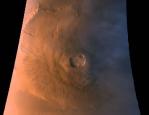 Haunting Mars
31.10.1997
This Halloween, the news about Mars is good news - Mars Global Surveyor will resume aerobraking into a mapping orbit around the haunting red planet. Wide angle cameras onboard the spacecraft recently recorded this shadowy image of Olympus Mons, the Solar System's largest volcano, from an altitude of over 100 miles.
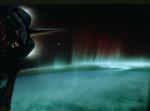 Southern Lights and Shuttle Glow
22.02.1998
A background of distant stars, sinuous and spiky bands of Southern Lights (Aurora Australis), and the faint glow of charged plasma (ionized atomic gas) surrounding the Space Shuttle Discovery's engines give this photo from the STS-39 mission an eerie, otherworldly look.
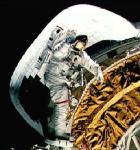 Space Walz
11.02.1997
Astronaut Carl Walz waves at his colleagues from the aft end of the Space Shuttle Discovery's payload bay - during a 1993 spacewalk to evaluate tools, tethers, and a foot restraint slated for use in the first Hubble Space Telescope servicing mission.
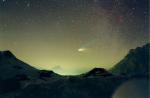 Comet Hale Bopp Over Val Parola Pass
14.03.2004
Comet Hale-Bopp became much brighter than any surrounding stars. It was seen even over bright city lights. Out away from city lights, however, it put on quite a spectacular show. Here Comet Hale-Bopp was photographed above Val Parola Pass in the Dolomite mountains surrounding Cortina d'Ampezzo, Italy.
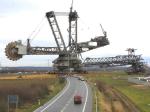 A Bucket Wheel Excavator on Earth
22.11.2006
Please wait while one of the largest mobile machines in the world crosses the road. The machine pictured above is a bucket-wheel excavator used in modern surface mining. Machines like this have given humanity the ability to mine minerals and change the face of planet Earth in new and dramatic ways.
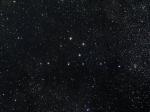 Collinder 399: The Coat Hanger
12.01.2007
Is this coat hanger a star cluster or an asterism? This cosmic hang-up has been debated over much of last century, as astronomers wondered whether this binocular-visible object is really a physically associated open cluster or a chance projection. Chance star projections are known as asterisms, an example of which is the popular Big Dipper.
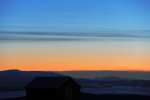 Mercury and Jupiter at Sunset
18.03.2011
When warm sunset hues begin to fade, two celestial beacons now shine in the evening twilight, Mercury and Jupiter. Wandering away from the Sun in planet Earth's sky, Mercury will offer good views this month as spring approaches in the northern hemisphere where the ecliptic plane makes a steep angle with the western horizon.
|
January February March April May June July August September |
|||||||||||||||||||||||||||||||||||||||||||||||||