
|
You entered: orbit
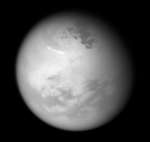 Northern Summer on Titan
20.06.2020
Today's solstice brings summer to planet Earth's northern hemisphere. But the northern summer solstice arrived for ringed planet Saturn over three years ago on May 24, 2017. Orbiting the gas giant, Saturn's moon Titan experiences the Saturnian seasons.
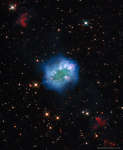 Jets from the Necklace Nebula
18.05.2021
What celestial body wears the Necklace Nebula? First, analyses indicate that the Necklace is a planetary nebula, a gas cloud emitted by a star toward the end of its life. Also, what appears to be diamonds in the Necklace are actually bright knots of glowing gas.
 Jupiter and the Geminid
28.12.2023
For a brief moment, this brilliant fireball meteor outshone Jupiter in planet Earth's night. The serendipitous image was captured while hunting meteors under cold Canadian skies with a camera in timelapse mode on December 14, near the peak of the Geminid meteor shower.
 APOD: 2024 December 15 Б Geminid Meteors over a Snowy Forest
15.12.2024
Meteors have been flowing out from the constellation Gemini. This was expected, as mid-December is the time of the Geminid Meteor Shower. Pictured here, over two dozen meteors were caught in successively added exposures taken over several hours early Saturday morning from a snowy forest in Poland.
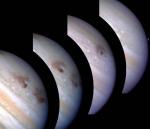 Jupiter Swallows Comet Shoemaker Levy 9
5.11.2000
What happens when a comet encounters a planet? If the planet has a rocky surface, a huge impact feature will form. A giant planet like Jupiter, however, is mostly gas. When Comet Shoemaker-Levy 9 struck Jupiter in 1994, each piece was swallowed into the vast Jovian atmosphere.
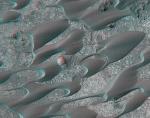 Mars: 3 D Dunes
15.08.2001
Get out your red/blue glasses and treat yourself to this dramatic 3-D view of sand dunes on Mars! The field of undulating dunes is found in Nili Patera, a volcanic depression in central Syrtis Major, the most prominent dark feature on the Red Planet.
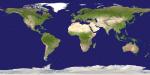 Earth in True Color
5.03.2002
Here are the true colors of planet Earth. Blue oceans dominate our world, while areas of green forest, brown mountains, tan desert, and white ice are also prominent. Oceans appear blue not only because water itself is blue but also because seawater frequently scatters light from a blue sky.
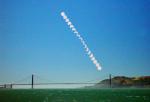 A Partial Eclipse Over the Golden Gate Bridge
12.06.2002
Part of the Sun disappeared behind the Moon earlier this week. Previously, the waning Moon was best visible from all places on Earth during the early morning hours because it trailed the Sun. As the Moon orbited the Earth, however, it caught up to the Sun and passed it on the sky.
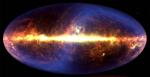 The Infrared Sky
28.01.1998
Three major sources contribute to the far-infrared sky: our Solar System, our Galaxy, and our Universe. The above image, in representative colors, is a projection of the entire infrared sky created from years of observations by the robot spacecraft COBE.
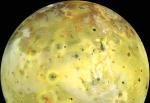 Io in True Color
20.09.1999
The strangest moon in the Solar System is bright yellow. This recently released picture, showing Io's true colors, was taken in July by the Galileo spacecraft currently orbiting Jupiter. Io's colors derive from sulfur and molten silicate rock. The unusual surface of Io is kept very young by its system of active volcanoes.
|
January February March April May June July August September |
|||||||||||||||||||||||||||||||||||||||||||||||||