
|
You entered: orbit
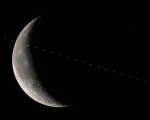 Trifecta at Twilight
20.02.2020
On February 18, as civil twilight began in northern New Mexico skies, the International Space Station, a waning crescent Moon, and planet Mars for a moment shared this well-planned single field of view. From...
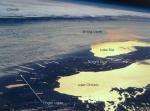 Smog Over New York
7.05.2002
What is not pretty about the above picture? In a word: smog. In 2000 October the orbiting Space Shuttle Discovery photographed update New York just at sunset. Visible is golden sunlight reflecting from two of the Great Lakes (Erie and Ontario), and several of the Finger Lakes.
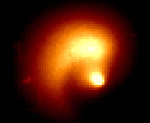 Comet Hale-Bopp Update
30.10.1995
Will comet Hale-Bopp become the brightest comet of the Century in early 1997? Since its discovery in July this year, Hale-Bopp has caused much speculation. Even though it is still beyond the orbit of Jupiter it is astonishingly bright and expected to get much brighter as it plunges inward, toward the Sun.
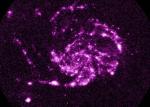 M101: An Ultraviolet View
8.06.1997
This giant spiral galaxy, Messier 101 (M101), was photographed by the Ultraviolet Imaging Telescope (UIT). UIT flew into orbit as part of the Astro 2 mission on-board the Space Shuttle Endeavour in March 1995. The image has been processed so that the colors (purple to white) represent an increasing intensity of ultraviolet light.
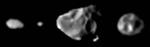 Jupiter's Inner Moons
27.11.1997
The potato-shaped inner moons of Jupiter are lined-up in this mosaic "family portrait" of these tiny Jovian satellites. The individual images were recorded over the last year by NASA's Galileo spacecraft and are scaled to the moons' relative sizes.
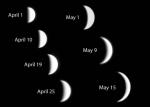 Phases of Venus
21.05.2004
Venus is currently falling out of the western evening sky. Second planet from the Sun and third brightest celestial object after the Sun and Moon, Venus has been appreciated by casual sky gazers as a brilliant beacon above the horizon after sunset. But telescopic images have also revealed its dramatic phases.
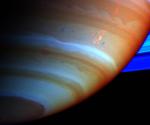 Saturn s Dragon Storm
25.02.2005
Dubbed the "Dragon Storm", convoluted, swirling cloud features are tinted orange in this false-color, near-infrared image of Saturn's southern hemisphere. In one of a series of discoveries announced by Cassini researchers, the Dragon...
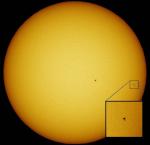 ISS and Discovery Transit the Sun
29.07.2005
That large sunspot near the right edge of the Sun is actually not a sunspot at all. It's the International Space Station (ISS) docked with the Space Shuttle Discovery on mission STS-114.
 Mercury on the Horizon
20.03.2000
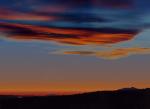
Have you ever seen the planet Mercury? Because Mercury orbits so close to the Sun, it is never seen far from the Sun, and so is only visible near sunrise or sunset. If trailing the Sun, Mercury will be visible for several minutes before it follows the Sun behind the Earth.
 A RADARSAT Map of Antarctica
16.11.1999
It's not easy to make a map of Antarctica. Earth's southern most continent is so cold and inhospitable that much of it remains unexplored. From space, though, it is possible to map this entire region by radar: by systematically noting how long it takes for radio waves to reflect off the terrain.
|
January February March April May June July August September |
|||||||||||||||||||||||||||||||||||||||||||||||||