
|
You entered: orbit
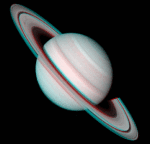 Stereo Saturn
12.02.2000
Get out your red/blue glasses and launch yourself into this stereo picture of Saturn! The picture is actually composed from two images recorded weeks apart by the Voyager 2 spacecraft during its visit to the Saturnian System in August of 1981.
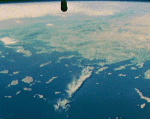 Aristarchus' Unbelievable Discoveries
8.11.1997
Here lived one of the greatest thinkers in human history. Aristarchus lived on the Greek island of Samos, a small island in the center of the above picture that can be identified with a good map.
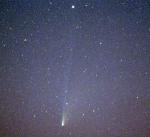 Bright Comet SOHO
21.05.1998
Discovered this month with an orbiting solar observatory, bright Comet SOHO has now emerged from the Sun's glare. This telephoto picture of the new naked-eye comet was taken by astrophotographer Michael Horn after sunset in the western twilight above Lake Samsonvale, Brisbane, Australia on May 18. The comet is seen in the constellation Orion.
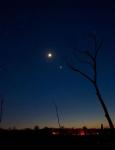 A Western Sky at Twilight
1.05.2004
On April 23rd, the Moon along with planets Saturn, Mars, and Venus (and planet Earth of course ...) were all visible in the west at twilight, captured here from a site near Saylorvillle Lake north of Des Moines, Iowa, USA.
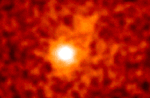 Gamma Ray Quasar
26.12.1998
The bright object in the center of the false color image above is quasar 3C279 viewed in gamma-rays, photons with more than 40 million times the energy of visible light. Like all quasars, 3C279 is a nondescript, faint, star-like object in the visible sky.
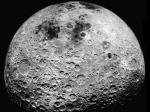 The Far Side of the Moon
25.02.2007
Does this moon look familiar? Possibly not, even though it is Earth's Moon. Locked in synchronous rotation, the Moon always presents its well-known near side to Earth. But from lunar orbit, Apollo astronauts also grew to know the Moon's far side.
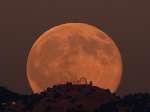 Lick Observatory Moonrise
12.12.2008
As viewed from a well chosen location at sunset, October's gorgeous Full Moon rose behind Mount Hamilton, east of San Jose, California. Captured in this lovely telescopic view, historic Lick Observatory is perched on the mountain's 4,200 foot summit, observatory and rising Moon momentarily sharing the warm color of filtered sunlight.
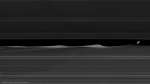 Daphnis and the Rings of Saturn
22.02.2017
What's happening to the rings of Saturn? Nothing much, just a little moon making waves. The moon is 8-kilometer Daphnis and it is making waves in the Keeler Gap of Saturn's rings using just its gravity -- as it bobs up and down, in and out.
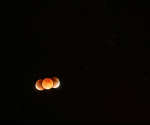 Earthshadow and the Beehive
3.02.2018
The Earth's dark umbral shadow is shaped like a cone extending into space. Of course its circular cross section at the distance of the Moon is more easily seen during a lunar eclipse.
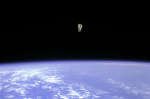 To Fly Free in Space
9.02.2020
What would it be like to fly free in space? At about 100 meters from the cargo bay of the space shuttle Challenger, Bruce McCandless II was living the dream -- floating farther out than anyone had ever been before. Guided by a Manned Maneuvering Unit (MMU), astronaut McCandless, pictured, was floating free in space.
|
January February March April May June July August September |
|||||||||||||||||||||||||||||||||||||||||||||||||