
|
You entered: orbit
 The Nearest Stars
17.03.2001
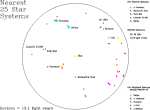
Which stars are closest to the Sun? The closest is Proxima Centauri, one of three stars that orbit each other about 4 light-years away in the Alpha-Centauri system. Alpha Centauri is easily visible from Earth's
 Venus Once Molten Surface
16.09.2001
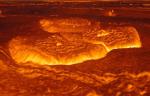
If you could look at Venus with radar eyes - this is what you might see. This computer reconstruction of the surface of Venus was created from data from the Magellan spacecraft. Magellan orbited Venus and used radar to map our neighboring planet's surface between 1990 and 1994.
 In the Center of the Whirlpool
25.04.1996
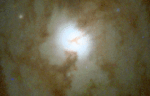
In the center of M51, a spiral galaxy 23 million light-years away, astronomers have identified a dense region of young stars. The graceful swirling arcs of this galaxy's spiral arms have inspired its popular name, "The Whirlpool Galaxy".
 Night and Day in Melas Chasma on Mars
15.12.2002
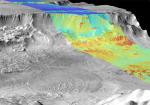
What types of terrain are found on Mars? Part of the answer comes from thermal imaging by the robot spacecraft 2001 Mars Odyssey currently orbiting Mars. The above picture is a superposition of two infrared images, a black and white image taken during Martian daylight and a false-color image taken at night.
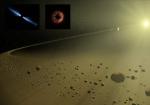 Debris Disks Surround Distant Suns
9.12.2004
In this dramatic artist's vision, debris along the outer reaches of a planet forming disk orbits in the glare of a distant sun. But inset are actual images of such disks around two nearby stars - AU Microscopii (top left; edge-on) and HD107146 (right: face-on) - as seen by the Hubble Space Telescope.
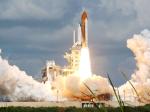 America Returns to Space Flight
27.07.2005
NASA's launch of the massive Space Shuttle Discovery yesterday brought a nation known for its tremendous space program back to human space flight. Shuttle flights had been suspended for over two years previously following the tragic loss of the Space Shuttle Columbia crew on 2003 February 1.
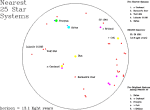 The Nearest Stars
21.04.1999
Which stars are closest to the Sun? The closest is Proxima Centauri, one of three stars that orbit each other about 4 light-years away in the Alpha-Centauri system. Alpha Centauri is easily visible from Earth's Southern Hemisphere. Next is Barnard's Star, a dim star visible with a telescope in the constellation of Ophiuchus.
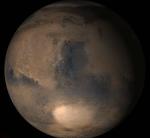 Northern Spring on Mars
24.03.2006
Astronomical spring came to planet Earth's northern hemisphere this week (and autumn to the south) with the equinox on March 20th. But on Mars, northern spring began on January 22nd. Still in northern...
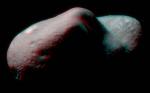 Stereo Eros
23.02.2000
Get out your red/blue glasses and float next to asteroid 433 Eros, 260 million kilometers away! Orbiting the Sun once every 1.8 earth-years, asteroid Eros is a diminutive 40 x 14 x 14 kilometer world of undulating horizons, craters, boulders and valleys.
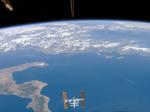 Space Station Over the Ionian Sea
26.11.2007
Last August, the Space Shuttle Endeavor crew captured this shot of the International Space Station (ISS) against the backdrop of Planet Earth. During that trip to the ISS, the space shuttle crew re-supplied the station, repaired the station, and even built more of the station.
|
January February March April May June July August September |
|||||||||||||||||||||||||||||||||||||||||||||||||