
|
You entered: Sun
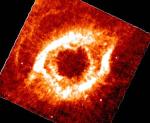 Infrared Helix
1.09.1997
Five hundred light years from Earth, in the constellation Aquarius, a sun-like star is dying. Its last few thousand years have produced the Helix, a well studied and nearby example of a Planetary Nebula - typical of this final phase of stellar evolution.
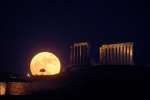 Solstice Moonrise, Cape Sounion
20.06.2008
Today's solstice marks the northernmost point of the Sun's annual motion through planet Earth's sky and the astronomical beginning of the northern hemisphere's summer. But only two days ago, the Full Moon nearest the solstice rose close to the ecliptic plane opposite the Sun, near its southernmost point for the year.
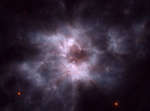 NGC 2440: Pearl of a New White Dwarf
16.05.2015
Like a pearl, a white dwarf star shines best after being freed from its shell. In this analogy, however, the Sun would be a mollusk and its discarded hull would shine prettiest of all!
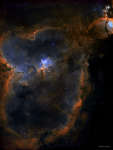 Bright from the Heart Nebula
26.10.2015
What's that inside the Heart Nebula? First, the large emission nebula dubbed IC 1805 looks, in whole, like a human heart. The nebula glows brightly in red light emitted by its most prominent element: hydrogen.
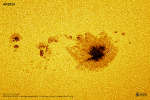 AR2835: Islands in the Photosphere
1.07.2021
Awash in a sea of incandescent plasma and anchored in strong magnetic fields, sunspots are planet-sized dark islands in the solar photosphere, the bright surface of the Sun. Found in solar active regions, sunspots...
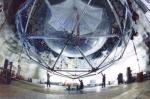 Sudbury Indicates Nonstandard Particle Model
10.07.2001
The Sudbury Neutrino Observatory (SNO) has been detecting so few neutrinos from the Sun that the Standard Model of fundamental particles in the universe may have to be revised. Pictured above is the SNO as it was being built.
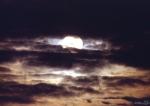 Partial Eclipse, Cloudy Day
20.12.2001
Welcome to the December Solstice, first day of winter in the north and summer in the southern hemisphere of planet Earth. Today the Sun reaches its southernmost declination in the sky at 19:21 Universal Time.
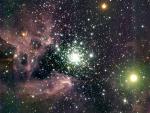 NGC 3603: An Active Star Cluster
18.10.1999
NGC 3603 is home to a massive star cluster, thick dust pillars, and a star about to explode. The central open cluster contains about 2000 bright stars, each of which is much brighter and more massive than our Sun.
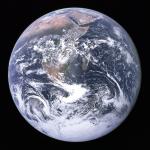 Welcome to Planet Earth
24.03.2007
Welcome to Planet Earth, the third planet from a star named the Sun. The Earth is shaped like a sphere and composed mostly of rock. Over 70 percent of the Earth's surface is water. The planet has a relatively thin atmosphere composed mostly of nitrogen and oxygen.
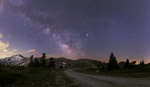 Milky Way and Planets Near Opposition
20.05.2016
In this early May night skyscape, a mountain road near Bursa, Turkey seems to lead toward bright planets Mars and Saturn and the center of our Milky Way Galaxy, a direction nearly opposite the Sun in planet Earth's sky.
|
January February March April May June July August |
||||||||||||||||||||||||||||||||||||||||||||||||||||||||