
|
You entered: Sun
 Good Morning Planets from Chile
17.06.2022
On June 15, innermost planet Mercury had wandered about as far from the Sun as it ever gets in planet Earth's sky. Near the eastern horizon just before sunrise it stands over distant Andes mountain peaks in this predawn snapshot from the valley of Rio Hurtado in Chile.
 September Sunrise Shadows
24.09.2022
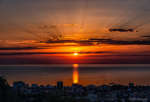
The defining astronomical moment for this September's equinox was on Friday, September 23, 2022 at 01:03 UTC, when the Sun crossed the celestial equator moving south in its yearly journey through planet Earth's sky.
 Stars and the Bubble Nebula
28.03.2004
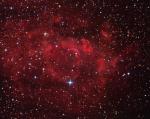
Seemingly adrift in a cosmic sea of stars and gas, this delicate, floating apparition is cataloged as NGC 7635 -- The Bubble Nebula. In this wide-angle view, the Bubble nebula lies at the center of a larger complex of shocked glowing gas about 11,000 light-years distant in the fair constellation Cassiopeia.
 Venus: Earths Cloudy Twin
16.05.2004
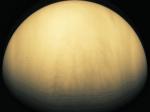
This picture by the Galileo spacecraft shows just how cloudy Venus is. Venus is very similar to Earth in size and mass - and so is sometimes referred to as Earth's sister planet - but Venus has a quite different climate.
 S is for Venus
7.01.2005
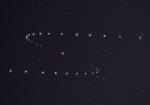
Planet Venus traced out this S shape in Earth's sky during 2004. Following the second planet from the Sun in a series of 29 images recorded from April 3rd through August...
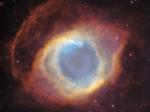 The Helix Nebula from Blanco and Hubble
29.12.2004
How did a star create the Helix nebula? The shapes of planetary nebula like the Helix are important because they likely hold clues to how stars like the Sun end their lives. Recent observations...
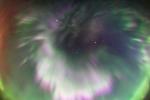 Northern Lights, September Skies
16.09.2005
So far, the Aurora Borealis or Northern Lights have made some remarkable visits to September's skies. The reason, of course, is the not-so-quiet Sun. In particular, a large solar active region now crossing...
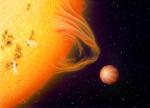 Upsilon Andromedae: An Extra Solar System
16.04.1999
Yesterday, astronomers announced the discovery of the first system of planets around a normal star other than our Sun. Previously, only single planet star systems had been found. Subtle changes in the wobble of Upsilon Andromedae, a Sun-like star in the constellation of Andromeda, allowed astronomers led by R. Paul Butler (AAO) and Geoffrey W.
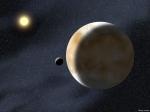 Eris: More Massive than Pluto
19.06.2007
Eris, a dwarf planet currently orbiting the Sun at about twice Pluto's distance, has been measured to have about 27 percent more mass than Pluto. The mass was calculated by timing the orbit of Eris' moon Dysnomia.
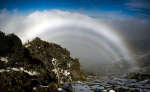 A Hall of Mountain Glory
4.05.2010
If you tried to enter this hall of fog, you would find it dissipates around you. The hall is actually an the mountain from which this picture was taken. Known as "the glory", the phenomenon is frequently seen from airplanes.
|
January February March April May June July August |
||||||||||||||||||||||||||||||||||||||||||||||||||||||||