
|
You entered: Sun
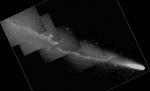 Comet Ikeya-Zhangs Busy Tail
18.03.2002
One of the brightest comets of the past five years will likely reach its peak brightness this week. Comet Ikeya-Zhang, officially known as C/2002 C1, can now be seen without aide from a dark location above the western horizon shortly after sunset.
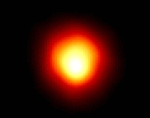 Betelgeuse, Betelgeuse, Betelgeuse
22.01.1996
Betelgeuse (sounds a lot like "beetle juice"), a red supergiant star about 600 lightyears distant, is shown here in this Hubble Space Telescope image which represents the first direct picture of the surface of a star other than the Sun.
 The Belt of Venus over the Valley of the Moon
23.07.2006
Although you've surely seen it, you might not have noticed it. During a cloudless twilight, just before sunrise or after sunset, part of the atmosphere above the horizon appears slightly off-color, slightly pink.
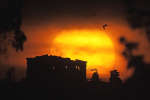 Sunrise over the Parthenon
21.06.2009
Today, the sun will stay in the sky longer than any other day of the year, as seen from the northern hemisphere of Earth. Named the Summer Solstice, today's maximum daylight is indicative of the high amount of sunlight this time of year that is primarily responsible for the heat of the summer season.
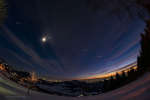 Planetary Alignment over Italy
19.12.2021
It is not a coincidence that planets line up. That's because all of the planets orbit the Sun in (nearly) a single sheet called the plane of the ecliptic. When viewed from inside that plane -- as Earth dwellers are likely to do -- the planets all appear confined to a single band.
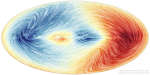 Milky Way Motion in 3D from Gaia
6.07.2022
Our sky is alive with the streams of stars. The motions of 26 million Milky Way stars are evident in the featured map constructed from recent data taken by ESA's Gaia satellite. Stars colored blue are moving toward us, while red indicates away. Lines depict the motion of the stars across the sky.
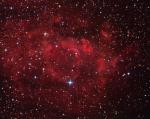 Stars and the Bubble Nebula
17.01.2003
Seemingly adrift in an cosmic sea of stars and gas, this delicate, floating apparition is cataloged as NGC 7635 -- The Bubble Nebula. In this wide-angle view, the Bubble nebula lies at the center of a larger complex of shocked glowing gas about 11,000 light-years distant in the fair constellation Cassiopeia.
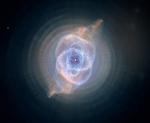 Cat s Eye
10.09.2004
Staring across interstellar space, the alluring Cat's Eye nebula lies three thousand light-years from Earth. A classic planetary nebula, the Cat's Eye (NGC 6543) represents a final, brief yet glorious phase in the life of a sun-like star.
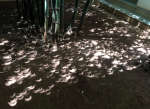 Eclipse under the Bamboo
26.06.2020
Want to watch a solar eclipse safely? Try looking down instead of up, though you might discover you have a plethora of images to choose from. For example, during the June 21st solar eclipse this confusing display appeared under a shady bamboo grove in Pune, India.
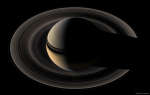 Crescent Saturn
8.08.2020
From Earth, Saturn never shows a crescent phase. But when viewed from a spacecraft the majestic giant planet can show just a sunlit slice. This image of crescent Saturn in natural color was taken by the robotic Cassini spacecraft in 2007.
|
January February March April May June July August |
||||||||||||||||||||||||||||||||||||||||||||||||||||||||