
|
You entered: Sun
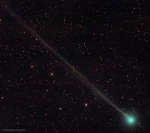 Comet 45P Returns
2.01.2017
An old comet has returned to the inner Solar System. Not only is Comet 45P/HondaMrkosPajduАkovА physically ancient, it was first discovered 13 orbits ago in 1948. Comet 45P spends most of its time out near the orbit of Jupiter and last neared the Sun in 2011.
 APOD: 2024 September 23 Б Comet Tsuchinshan ATLAS Approaches
23.09.2024
What will happen as this already bright comet approaches? Optimistic predictions have Comet C/2023 A3 (TsuchinshanБATLAS) briefly becoming easily visible to the unaided eye -- although the future brightness of comets are notoriously hard to predict, and this comet may even break up in warming sunlight.
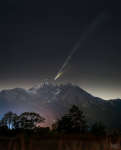 APOD: 2025 November 4 Б Comet Lemmon Beyond Lomnickц Peak
4.11.2025
Comet Lemmon has been putting on a show for cameras around the globe. Passing nearest to Earth in late October, the photogenic comet C/2025 A6 (Lemmon) sprouted two long and picturesque tails: a blue ion tail and a white dust tail.
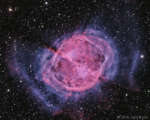 M27: The Dumbbell Nebula
2.11.2016
The first hint of what will become of our Sun was discovered inadvertently in 1764. At that time, Charles Messier was compiling a list of diffuse objects not to be confused with comets.
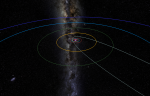 Animation: Perseid Meteor Shower
8.08.2018
Where do Perseid meteors come from? Mostly small bits of stony grit, Perseid meteoroids were once expelled from Comet Swift-Tuttle and continue to follow this comet's orbit as they slowly disperse. The featured animation depicts the entire meteoroid stream as it orbits our Sun.
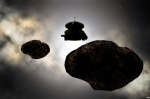 New Horizons at Ultima Thule
29.12.2018
When we celebrate the start of 2019, on January 1 the New Horizons spacecraft will flyby Ultima Thule. A world of the Kuiper belt 6.5 billion kilometers from the Sun, the nickname Ultima Thule (catalog designation 2014 MU69) fittingly means "beyond the known world".
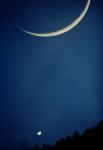 Moon And Venus Share The Sky
28.07.2000
July is drawing to a close and in the past few days, some early morning risers could have looked east and seen a crescent Moon sharing the pre-dawn skies with planets Jupiter and Saturn.
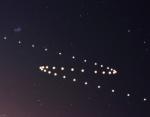 Z is for Mars
22.04.2006
This composite of images spaced about a week apart - from late July 2005 (bottom right) through February 2006 (top left) - traces the retrograde motion of ruddy-colored Mars through planet Earth's night sky. On November 7th, 2005 the Red Planet was opposite the Sun in Earth's sky (at opposition).
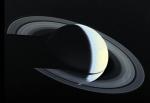 Saturn At Night
4.03.2000
From a spectacular vantage point over 1.4 billion kilometers from the sun, the Voyager 1 spacecraft looked back toward the inner solar system to record this startling view of Saturn's nightside. The picture was taken on November 16, 1980, some four days after the robot spacecraft's closest approach to the gorgeous gas giant.
 Green Flash at Moonrise
5.06.2015
Follow a sunset on a clear day against a distant horizon and you might glimpse a green flash just as the Sun disappears, the sunlight briefly refracted over a long sight-line through atmospheric layers. You can spot a green flash at sunrise too.
|
January February March April May |
|||||||||||||||||||||||||||||||||||||||||||||||||