
|
You entered: Sun
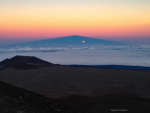 Full Moon in Mountain Shadow
20.10.2016
On October 15, standing near the summit of Hawaii's Mauna Kea and looking away from a gorgeous sunset produced this magnificent snapshot of a Full Moon rising within the volcanic mountain's shadow. An alignment across the Solar System is captured in the stunning scene and seeming contradiction of bright Moon in dark shadow.
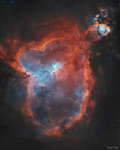 IC 1805: The Heart Nebula
10.09.2019
What energizes the Heart Nebula? First, the large emission nebula dubbed IC 1805 looks, in whole, like a human heart. The nebula glows brightly in red light emitted by its most prominent element: hydrogen. The red glow and the larger shape are all powered by a small group of stars near the nebula's center.
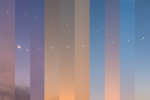 10 Days of Venus and Jupiter
3.03.2023
Venus and Jupiter may have caught your attention lately. The impending close conjunction of the two brightest planets visible in clear evening skies has been hard to miss. With Jupiter at the top, starting...
 APOD: 2025 September 30 Б Comet Lemmon Brightens
29.09.2025
Comet Lemmon is brightening and moving into morning northern skies. Besides Comet SWAN25B and Comet ATLAS, Comet C/2025 A6 (Lemmon) is now the third comet currently visible with binoculars and on long camera exposures. Comet Lemmon was discovered early this year and is still headed into the inner Solar System.
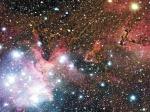 In the Center of the Heart Nebula
7.12.2004
What powers the Heart Nebula? The large emission nebula dubbed IC 1805 looks, in whole, like a human heart. The nebula glows brightly in red light emitted by its most prominent element: hydrogen. The red glow and the larger shape are all created by a small group of stars near the nebula's center.
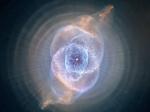 The Cats Eye Nebula from Hubble
13.05.2007
Staring across interstellar space, the alluring Cat's Eye nebula lies three thousand light-years from Earth. A classic planetary nebula, the Cat's Eye (NGC 6543) represents a final, brief yet glorious phase in the life of a sun-like star.
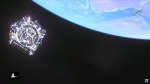 James Webb Space Telescope over Earth
25.12.2021
There's a big new telescope in space. This one, the James Webb Space Telescope (JWST), not only has a mirror over five times larger than Hubble's in area, but can see better in infrared light.
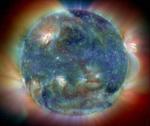 Solstice Celebration
21.06.2000
Season's greetings! At 01:48 Universal Time on June 21 the Sun reaches its northernmost point in planet Earth's sky marking a season change and the first solstice of the year 2000. In celebration, consider this delightfully detailed, brightly colored image of the active Sun.
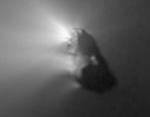 Halley s Nucleus: An Orbiting Iceberg
5.08.2000
What does a comet nucleus look like? Formed from the primordial stuff of the solar system, it is thought to resemble a very dirty iceberg. But for active comets, telescopic images only reveal the surrounding cloud of gas and dust, the comet's coma, and the characteristic cometary tails.
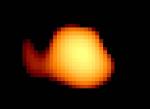 Resolving Mira
13.08.1997
Most stars appear only as points of light. Recently, Betelgeuse became the second star, after our Sun, to have it surface resolved. Now add Mira to the list. Mira A is a red giant star undergoing dramatic pulsations, causing it to become more than 100 times brighter over the course of a year.
|
January February March April May |
|||||||||||||||||||||||||||||||||||||||||||||||||