
|
You entered: rings
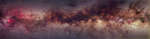 A Milky Way Band
10.07.2011
Most bright stars in our Milky Way Galaxy reside in a disk. Since our Sun also resides in this disk, these stars appear to us as a diffuse band that circles the sky.
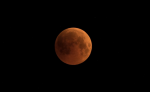 A Total Lunar Eclipse Video
20.01.2019
Tonight a bright full Moon will fade to red. Tonight's moon will be particularly bright because it is reaching its fully lit phase when it is relatively close to the Earth in its elliptical orbit.
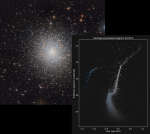 The Colors and Magnitudes of M13
13.06.2019
M13 is modestly recognized as the Great Globular Star Cluster in Hercules. A ball of stars numbering in the hundreds of thousands crowded into a region 150 light years across, it lies some 25,000 light-years away. The sharp, color picture of M13 at upper left is familiar to many telescopic imagers.
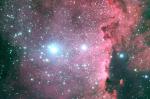 Hot Stars in the Southern Milky Way
7.05.1999
Hot blue stars, red glowing hydrogen gas, and dark, obscuring dust clouds are strewn through this dramatic region of the Milky Way in the southern constellation of Ara (the Altar). About 4,000 light-years from Earth, the stars at the left are young, massive, and energetic.
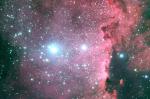 Hot Stars in the Southern Milky Way
22.12.2001
Hot blue stars, red glowing hydrogen gas, and dark, obscuring dust clouds are strewn through this dramatic region of the Milky Way in the southern constellation of Ara (the Altar). About 4,000 light-years from Earth, the stars at the left are young, massive, and energetic.
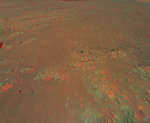 Jezero Crater: Raised Ridges in 3D
7.08.2021
Get out your red-blue glasses and hover over the surface of Mars. Taken on July 24, the 3D color view is from the Mars Ingenuity Helicopter's 10th flight above the Red Planet.
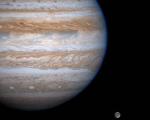 Jupiter Eyes Ganymede
12.12.2000
Who keeps an eye on the largest moon in the Solar System? This moon, visible on the lower right, is Ganymede, and the planet it orbits, Jupiter, seems to be keeping a watchful eye, as its Great Red Spot appears serendipitously nearby.
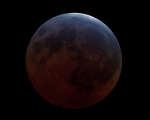 Full Moon in Earth's Shadow
8.04.2015
Last week the Full Moon was completely immersed in Earth's dark umbral shadow, just briefly though. The total phase of the April 4, 2015 lunar eclipse lasted less than 5 minutes, the shortest total lunar eclipse of the century.
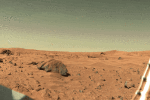 If You Could Stand on Mars
7.02.1996
If you could stand on Mars - what would you see? Viking 1 robot landers answered this question in 1976 with pictures like the one shown above. The dark rocks, red soil, and green-tinged sky grace this rendition of a normal Martian afternoon. At the bottom corners of the picture are portions of Viking spacecraft.
 The First Image of an Extra Solar Planet
10.05.2005
It's the faint red object, not the bright white one that might be a historic find. The white object is surely a brown dwarf star. Quite possibly, however, the red object is the first direct image of a planet beyond our Solar System.
|
January February March April May |
|||||||||||||||||||||||||||||||||||||||||||||||||