
|
You entered: rings
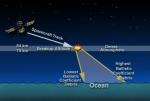 Compton Reentry
3.06.2000
Nine years ago the massive Compton Gamma Ray Observatory, the second of NASA's space-based great observatories, was deployed in low earth orbit. Lofted above the protective atmosphere, Compton's instruments could explore the extreme high-energy Universe in gamma rays -- photons with 100,000 times or more the energy of visible light.
 APOD: 2023 August 2 Б M82: Galaxy with a Supergalactic Wind
2.08.2023
Why is the Cigar Galaxy billowing red smoke? M82, as this starburst galaxy is also known, was stirred up by a recent pass near large spiral galaxy M81. This doesn't fully explain the source of the red-glowing outwardly expanding gas and dust, however.
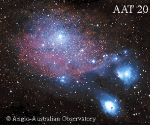 Nebulosity in Sagittarius
18.07.1996
What causes the colors in this beautiful nebulosity in Sagittarius? Dubbed NGC 6589 and NGC 6590, the colors of this nebulosity, are caused by gas and dust. The blue color of the nebula nearest the bright stars is caused by reflection off interstellar dust.
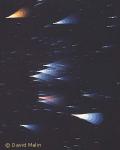 Orion Star Colours
29.08.1998
What determines a star's colour? Its temperature. Red stars are cool, around 3,000 kelvins (K), while blue stars are hotter and can have temperatures over 30,000 K. Our own lovely yellow Sun's temperature is a comforting 6,000 K.
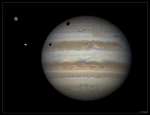 Shadows Across Jupiter
15.02.2013
Two dark shadows loom across the banded and mottled cloud tops of Jupiter in this sharp telescopic view. In fact, captured on January 3rd, about a month after the ruling gas giant appeared at opposition in planet Earth's sky, the scene includes the shadow casters.
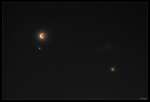 Spica, Mars, and Eclipsed Moon
16.04.2014
A beautiful, reddened Moon slid through dark skies on April 15, completely immersed in Earth's shadow for well over an hour. It was the year's first total lunar eclipse and was widely enjoyed over the planet's Western Hemisphere.
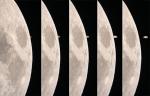 Saturn at the Lunar Limb
22.02.2002
Gliding through the sky on Wednesday evening, February 20th, a first quarter Moon seemed to run over bright planet Saturn as viewed from much of North America. In this sharp sequence of telescopic digital...
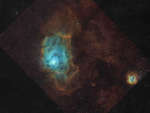 The Lagoon Nebula in Gas, Dust, and Stars
22.07.2009
Stars are battling gas and dust in the Lagoon Nebula but the photographers are winning. Also known as M8, this photogenic nebula is visible even without binoculars towards the constellation of Sagittarius. The energetic processes of star formation create not only the colors but the chaos.
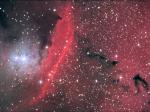 In the Center of NGC 6559
29.06.2004
Bright gas and dark dust permeate the space between stars in the center of a nebula known as NGC 6559. The gas, primarily hydrogen, is responsible for the diffuse red glow of the emission nebula.
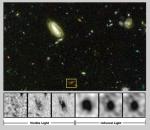 Pick a Galaxy Any Galaxy
17.01.2002
Pick a galaxy, any galaxy. In the top panel you can choose from a myriad of distant galaxies revealed in a deep Hubble Space Telescope image of a narrow slice of the cosmos toward the constellation Hercules.
|
January February March April May |
|||||||||||||||||||||||||||||||||||||||||||||||||